The Performance of Red Flares Mg/Sr(NO₃)₂/PVC Compositions Modified with KIO₄ Additives
DOI:
https://doi.org/10.55749/ijcs.v5i1.103Keywords:
Burning rate, Light intensity, Red flare pyrotechnics, Potassium periodate, WavelengthAbstract
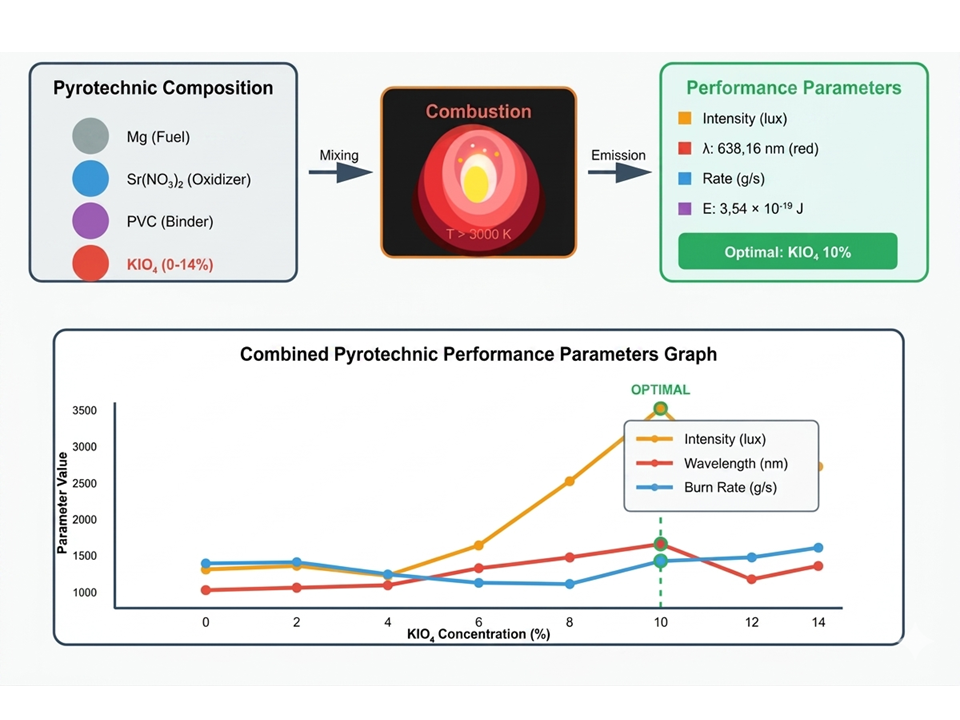
This study analyzes the enhancement of red signal flare efficacy for defense applications by formulating Mg/Sr(NO₃)₂/PVC-based pyrotechnics, utilizing various quantities of potassium periodate (KIO₄) as a secondary oxidizer. The addition of KIO₄ is significant as it provides extra oxygen, modifies combus6tion kinetics, raises flame temperature, and enhances the stimulating effect of red-emitting species—mechanisms that together may increase luminous output and stabilize the emitted spectrum band. Performance was assessed by measuring light intensity, dominant wavelength, burn rate, and color purity; spectral and image-based color analyses were performed using ImageJ. Results indicate that formulations containing up to 10% KIO₄ achieve a peak light intensity of 3,173.33 lux, a dominant wavelength of 638.16 nm, a burn rate of 2.01 g/s, and an estimated photon-energy efficiency of 3.54 × 10⁻¹⁹ J, with red emission reaching optimal purity at this composition. Compared to the baseline formulation without KIO₄, KIO₄-containing compositions showed markedly higher intensity and improved spectral stability, faster and more consistent burn behavior, and enhanced color purity—whereas the formulation without KIO₄ exhibited lower luminous output, broader or shifted spectral features, and reduced color stability. The novelty of this work lies in applying potassium periodate as a secondary oxidizer in the Mg/Sr(NO₃)₂/PVC system—an approach that, to our knowledge, has been little explored—and demonstrating its dual benefit for optical performance and combustion behavior. The findings support the recommendation of the 10% KIO₄ formulation as the most effective balance of visual and combustion performance for red signal flares.
References
[1] Novyanto, S.A. and Faisol, A. 2022. Analysis of defense equipment procurement as a development of the defense industry in Indonesia. JNAJPM. 7(1). 85-98. doi: https://doi.org/10.47200/jnajpm.v7i1.1158
[2] Marsudiyanto, A. 2025. Addressing fiscal gap between budget availability and financing needs for Indonesian defense strategies. Asian J. Account. Res. 10(4). 430-455. doi: https://doi.org/10.1108/AJAR-10-2024-0417
[3] Grobler, J.M., Focke, W.W., Derrick, N.P., Oberholster, A.J., Kelly, C. and Labuschagne, G. 2020. Sensitising the micron-sized aluminium/potassium periodate thermite. J. Energ. Mater. 38(4). 455-466. doi: https://doi.org/10.1080/07370652.2020.1732499
[4] Zhang, M., Wang, Y., Zhang, C., Zeng, Y., Xiong, D., Ren, W., Huang, Q., Guo, K., Wu, P., Jia, Y. and Zhu, C. 2024. Tuning the performances of smoke-light signaling agents by Zn-Mg alloys. Chem. Eng. J. 502. 157932. doi: https://doi.org/10.1016/j.cej.2024.157932
[5] Wang, Y., Song, X., An, C. and Li, F. 2025. Luminescence performance of red pyrotechnics in the presence of high-energy explosives with different energetic groups. ACS Appl. Eng. Mater. 3(4). 1036-1050. doi: https://doi.org/10.1021/acsaenm.5c00117
[6] Mocella, C. and Conkling, J.A. 2019. Chemistry of pyrotechnics: basic principles and theory. CRC Press.
[7] Juknelevicius, D., Alenfelt, P. and Ramanavicius, A., 2020. The performance of red flare pyrotechnic compositions modified with gas generating additives. Propellants Explos. Pyrotech. 45(4). 671-679. doi: https://doi.org/10.1002/prep.201900322
[8] Liao, D., Lou, W., Feng, H., Kan, W., Li, Z. and Lu, Y. 2025. A review on the preparation and properties of energetic materials for micro pyrotechnic trains. Results Eng. 26. 105179. doi: https://doi.org/10.1016/j.rineng.2025.105179
[9] Guo, Z., Guan, H., Shi, C. and Zhou, B. 2024. Study of combustion characteristics of magnesium/strontium nitrate and magnesium/sodium nitrate pyrotechnics under low pressure environment. Combust. Sci. Technol. 196(15). 3365-3381. doi: https://doi.org/10.1080/00102202.2023.2175608
[10] Nedobukh, T.A. and Semenishchev, V.S. 2019. Strontium: source, occurrence, properties, and detection. In Strontium Contamination in the Environment (pp. 1-23). Cham: Springer International Publishing. doi: https://doi.org/10.1007/978-3-030-15314-4_1
[11] Shancita, I., Vaz, N.G., Fernandes, G.D., Aquino, A.J., Tunega, D. and Pantoya, M.L. 2021. Regulating magnesium combustion using surface chemistry and heating rate. Combust. Flame. 226. 419-429. https://doi.org/10.1016/j.combustflame.2020.12.024
[12] Moretti, J.D., Sabatini, J.J. and Chen, G., 2012. Periodate salts as pyrotechnic oxidizers: development of barium-and perchlorate-free incendiary formulations. Angew. Chem. - Int. Ed. 51(28). 6981-6983. https://doi.org/10.1002/anie.201202589
[13] Muradi, M., 2015. Defense industry funding model and human resource development. J. Pertahanan Bela Negara. 5(2). 213-224. doi: https://dx.doi.org/10.33172/jpbh.v5i2.365
[14] Kanitkar, S., Haynes, D., Sabolsky, E.M. and Chorpening, B. 2023. A review of colored light production by pyrotechnic materials. Propellants Explos. Pyrotech. 48(11). e202300012. doi: https://doi.org/10.1002/prep.202300012
[15] Patnaik, P., 2003. Handbook of inorganic chemicals (Vol. 529). 769-771. New York: McGraw-Hill.
[16] Prianto, B., 2008. Produksi amonium perklorat (NH4ClO4) sebagai simbol kemajuan teknologi roket dan rudal. Berita Dirgantara. 9(1).
[17] Gunaryo, Maharani, A., Budiman, A., Widyatama, S., Pratita, E., Miwazuki, S. 2024. Yellow-flare performance improvement of pvc addition into mg-sodium nitrate-based pyrotechics. Indones. J. Chem. Stud. 3(2). 66-71. doi: https://doi.org/10.55749/ijcs.v3i2.60
[18] Provatas, A., 2000. Energetic polymers and plasticisers for explosive formulations-A review of recent advances. Aeronautical and Maritime Research Laboratory: Australia.
[19] Sabatini, J.J. 2018. A Review of Illuminating Pyrotechnics. Propellants Explos. Pyrotech. 43(1). 28–37. https://doi.org/10.1002/prep.201700189
[20] Zhou, W., DeLisio, J.B., Wang, X. and Zachariah, M.R. 2017. Reaction mechanisms of potassium oxysalts based energetic composites. Combust. Flame. 177. 1-9. doi: https://doi.org/10.1016/j.combustflame.2016.05.024
[21] Sabatini, J.J. and Moretti, J.D., United States Department of the Army. 2018. Perchlorate-free red pyrotechnic illuminant compositions. U.S. Patent 9856181. https://patents.google.com/patent/US9856181B1/en
[22] Muraleedharan, K., Kannan, M.P. and Ganga, D.T., 2011. Thermal decomposition kinetics of potassium iodate. J. Therm. Anal. Calorim. 103(3). 943-955. doi: https://doi.org/10.1007/s10973-010-1162-5
[23] Dam, Q.S., Van Tuan Nguyen, T.H.H. and Nguyen, V.B. 2022. The preparation and characterization of the red flame composition based on strontium nitrate, magnesium, and polyvinyl chloride. J. Sci. Technol. 1859. 0209. doi: https://doi.org/https://doi.org/10.56651/lqdtu.jst.v17.n03
[24] Saputra, R.M., Somantri, G.R. and Subroto, A. 2024. The niche model of defense industry analysis: seeking the suffiency of indonesia’s needs main equipment and weaponery system (alutsista). Mandala J. Ilmu Hub. 7(1). 77-87. doi: https://doi.org/https://doi.org/10.33822/mjihi.v7i1.8038
[25] Ma, X., Zhao, W., Le, W., Li, J., Chen, P. and Jiao, Q. 2021. Synergetic effect of potassium oxysalts on combustion and ignition of Al/CuO composites. Nanomaterials. 11(12). 3366. doi: https://doi.org/10.3390/nano11123366
[26] Sebastian, E.S., Seco, J.M., Rodríguez‐Diéguez, A., Salinas‐Castillo, A. and Cepeda, J. 2024. Reversible guest‐induced long‐lasting luminescence. Organic and Inorganic Materials Based Sensors. 2. 729-772. Doi: https://doi.org/10.1002/9783527834266.ch32
[27] Klapötke, T.M. and Rusan, M. 2023. Nitrogen‐Rich Pyrotechnic Materials for Light and Smoke. Nitrogen‐Rich Energetic Materials. 397-414. doi: https://doi.org/10.1002/9783527832644.ch11
[28] Tibavinsky, I., Mazacioglu, A., & Sick, V. 2023. Spectroscopy of the 5s5p³P₀ → 5s5d³D₁ transition of strontium using laser-cooled atoms. arXiv preprint arXiv:2312.10327. https://arxiv.org/abs/2312.10327 doi: https://doi.org/10.48550/arXiv.2312.10327
[29] Montgomery, Y.C., Focke, W.W. and Kelly, C. 2017. Measurement and modelling of pyrotechnic time delay burning rates: Application and prediction of a fast burning delay composition. Propellants Explos. Pyrotech. 42(11). 1289-1295. doi: https://doi.org/10.1002/prep.201700105
[30] Sawan, S.E., Hamdy, Y.M. and Khattab, R.M. 2025. Investigation of the phosphorescence, persistent decay and structure properties of Eu2+: strontium aluminate doped with Nd3+, B3+ or Dy3+. BMC Chem. 19(1). 304. doi: https://doi.org/10.1186/s13065-025-01651-7
Downloads
Published
How to Cite
Issue
Section
License
Copyright (c) 2026 Indonesian Journal of Chemical Studies

This work is licensed under a Creative Commons Attribution-ShareAlike 4.0 International License.