Effect of Activated Carbon Addition on the Burning Rate and Energetic Characteristics of Sodium Nitrate–Sucrose Composite Solid Propellants
DOI:
https://doi.org/10.55749/ijcs.v5i1.159Keywords:
Activated carbon, Burning rate, Calorific value, Composite solid propellant, Sodium nitrate–SucroseAbstract
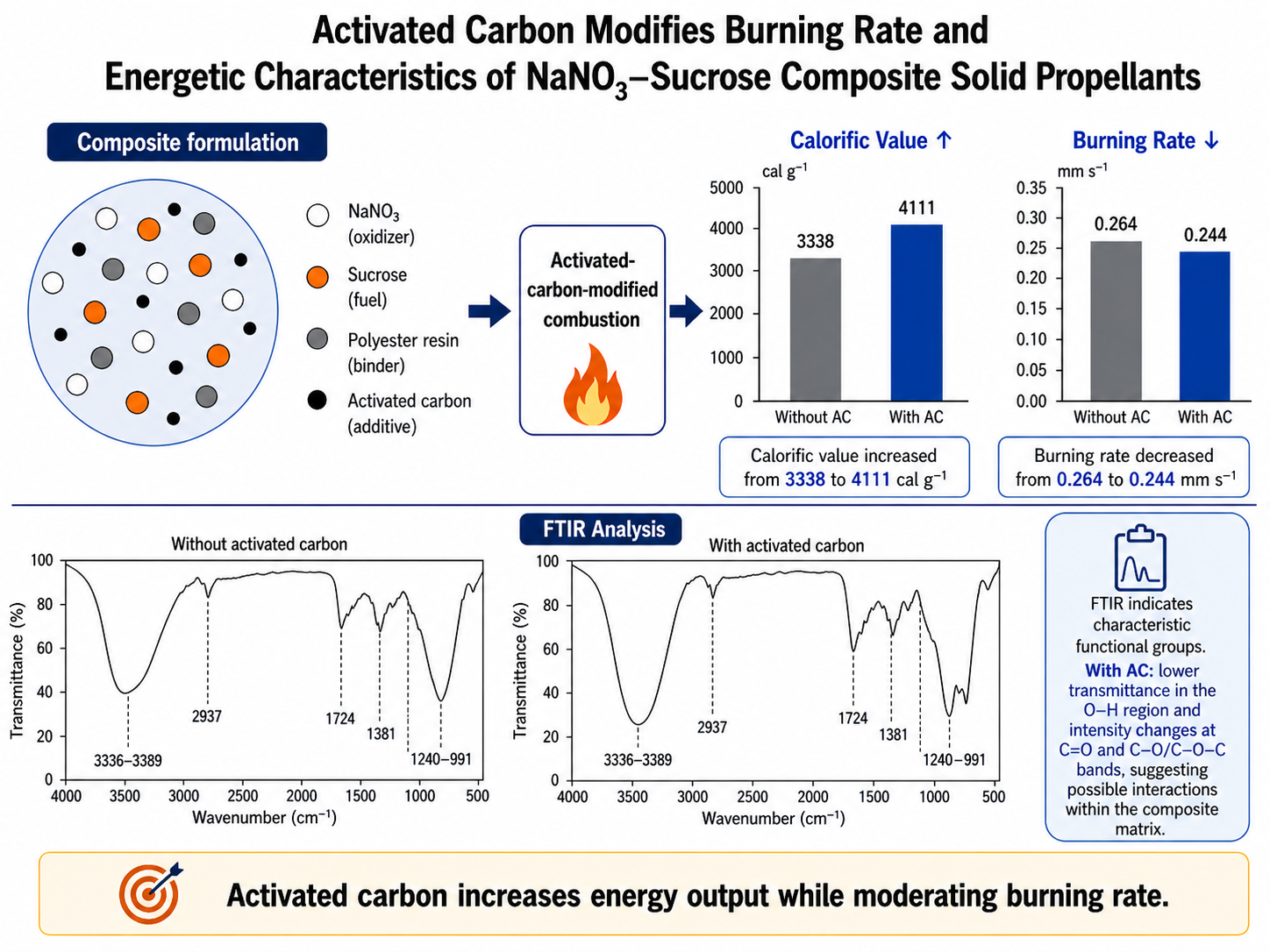
Composite solid propellants are widely used in rocket propulsion and gas-generating systems; however, many conventional formulations rely on chlorine-containing oxidizers that raise environmental concerns. This study evaluates a sodium nitrate–sucrose composite solid propellant and investigates the effect of activated carbon addition on combustion behavior and energetic characteristics. The propellant system consists of sodium nitrate as the oxidizer, sucrose as the fuel, unsaturated polyester resin as the binder, and activated carbon as a combustion-modifying additive. Two formulations, with and without activated carbon, were prepared to assess the influence of activated carbon on the composite system. The samples were characterized using visual inspection, linear burning-rate testing (n = 5), calorific value measurement by bomb calorimetry, Fourier Transform Infrared (FTIR) spectroscopy, and statistical analysis using Welch’s t-test (α = 0.05). The formulation containing activated carbon exhibited a more controlled burning rate and showed a statistically significant difference compared with the formulation without activated carbon. The calorific value increased from 3338 - 4111 cal g⁻¹, equivalent to 13.908 – 17.129 kJ g⁻¹, while the calculated reaction enthalpy (−968 cal g⁻¹) confirmed the exothermic nature of the base sodium nitrate–sucrose system. FTIR analysis indicated the presence of characteristic functional groups and suggested possible interactions within the composite matrix, particularly involving oxygen-containing groups and activated carbon. These results indicate that activated carbon functions as a combustion-modifying additive that influences both burning rate and energetic characteristics. The findings represent a preliminary laboratory-scale evaluation of formulation effects in sodium nitrate–sucrose composite solid propellants.
References
[1] Ilmi, N., Siahaan, T., Putra, I.N., Putra, R.D., & Haryanto, A. 2025. Analysis of Green Oxidizer Utilization in Composite Propellants and Its Implications for the Resilience of National Defense Systems. IJAR. 4(6). 639–656. Doi: https://doi.org/10.55927/ijar.v4i6.14678
[2] Ardianingsih, R. and Kumoro, A.C. 2019. Analisis viskositas slurry propelan untuk akurasi karakterisasi rheologi berbasis perekat hidroxy terminated polybutadiene dengan plasticizer dioctyl adipate. Teknik. 40(3). 154–160. Doi: https://doi.org/10.14710/teknik.v40i3.27209
[3] Bharti, M.K., Bansal, L., & Chalia, S. 2021. Catalytic potential of microsized additives in enhancing the linear burn rate of potassium nitrate-sucrose based composite solid propellant strands. Int. J. Energ. Mater. Chem. Propuls. 20(4). 61–77. Doi: https://doi.org/10.1615/IntJEnergeticMaterialsChemProp.2021038209
[4] Pandey, K.M., & Bose, P. 2016. Development of green propellants for short range solid rocket: an overview. Int. J. Eng. Res. 5(9). 596–599. Doi: https://doi.org/10.17577/ijertv5is090475
[5] Mason, B.P., & Roland, C.M. 2019. Solid propellants. Rubber Chem. Technol. 92(1). 1–24. Doi: https://doi.org/10.5254/rct.19.80456
[6] Lysien, K., Stolarczyk, A., & Jarosz, T. 2021. Solid propellant formulations : A review of recent progress. Materials (Basel). 14(21). 6657 1–17. Doi: https://doi.org/10.3390/ma14216657
[7] Wibowo, H.B. 2018. Current solid propellant research and development in Indonesia and its future direction. J. Phys. Conf. Ser. 1130(1). 1–8. Doi: https://doi.org/10.1088/1742-6596/1130/1/012027
[8] Muda, N.R.S., Wardana, I.W.I., Hamidi, N., Yuliati, L. and Setiawan, A.B. 2017, August. The total impulse study of solid propellants combustion containing activated carbon from coconut shell as a catalyst. In Proceedings of International Conference of Graduate School on Sustainability. 1(1). 425–433. doi: https://doi.org/10.26905/icgss.v1i1.1825
[9] Rodić, V., Bogosavljević, M., Brzić, S., & Fidanovski, B. 2018. Possibility of aluminium/magnesium exchange in composite rocket propellants. Sci. Tech. Rev. 68(1). 40–49. Doi: https://doi.org/10.5937/str1801040r
[10] Suharnoko, S., Sopamena, C.A., Jasmansyah, J., Murniati, A., & Hardian, A. 2023. Propellant development using local sources of nitrate compounds. al-Kimiya. 9(2). 96–102. Doi: https://doi.org/10.15575/ak.v9i2.20878
[11] Tigga, A.S., Murali, G., & Masthan Vali, P.S.N. 2023. Investigation on solid propellant test and time calibration for complete combustion. E3S Web Conf. 391. 1–16. Doi: https://doi.org/10.1051/e3sconf/202339101097
[12] Moody, K., Walsh, A., Ngo, A., Whyte, S., Stottlemyre, A., & Rouser, K. 2020. Development of sorbitol-based solid rocket motors for propulsion education. AIAA Scitech 2020 Forum. 1–19. Doi: https://doi.org/10.2514/6.2020-0067
[13] Morales, G.R.C. and Huanay, I.P.A. 2026. Development and characterization of alternative, environmentally friendly solid propellants based on renewable sugars and low-toxicity oxidants for aerospace applications. 1–12. Doi: https://doi.org/10.21203/rs.3.rs-8705658/v1
[14] Sangtyani, R., Saha, H.S., Kumar, A., Kumar, A., Gupta, M., & Chavan, P.V. 2019. An alternative approach to improve burning rate characteristics and processing parameters of composite propellant. Combust. Flame. 209. 357–362. Doi: https://doi.org/10.1016/j.combustflame.2019.04.054
[15] Knurr, B.J., & Hauri, J.F. 2020. An alternative to recycling: measurement of combustion enthalpies of plastics via bomb calorimetry. J. Chem. Educ. 97(5). 1465–1469. Doi: https://doi.org/10.1021/acs.jchemed.0c00076
[16] Hoque, E., Pant, C.S., & Das, S. 2021. Statistical evaluation of burning rate data of composite propellants obtained from acoustic emission technique. Def. Sci. J. 71(1). 18–24. Doi: https://doi.org/10.14429/dsj.71.16007
[17] Putri, L.O.N., & Nurhilal, O. 2022. Pemanfaatan arang aktif eceng gondok untuk material elektroda superkapasitor. JIIF J. Ilmu Inov. Fis. 6(2). 131–136. Doi: https://doi.org/10.24198/jiif.v6i2.39913
[18] ASTM International. 1997. ASTM D4809: Standard Test Method for Heat of Combustion of Liquid Hydrocarbon Fuels by Bomb Calorimeter. West Conshohocken, PA: ASTM International.
[19] Harvey, D., 2000. Modern analytical chemistry. 1. 423-433. New York: McGraw-Hill.
[20] Atkins, P., de Paula, J., & Keeler, J. 2018. Atkins’ Physical Chemistry (11th ed.). Oxford, UK: Oxford University Press.
[21] Guo, Z., Ju, J., Guan, H., Shi, C., & Li, Z. 2024. Study of combustion characteristics of magnesium/sodium nitrate pyrotechnics under sub-atmospheric pressure. Combust. Sci. Technol. 196(8). 1137–1151. Doi: https://doi.org/10.1080/00102202.2022.2111661
[22] Kumar, R., Sharma, D., Rao, Y.K.S.S., Kumar, A., Dubey, M., Mishra, S.K., & Yadav, A. 2025. Enhancing solid rocket propellants with nano-additives: a review of thermal and kinetic performance. Discov. Appl. Sci. 7(10). 1–31. Doi: https://doi.org/10.1007/s42452-025-07782-9
[23] Tsai, G., Kim, S., & Deng, S. 2024. Thermal interaction of inert additives in energetic materials. Proc. Combust. Inst. 40(1–4). Doi: https://doi.org/10.1016/j.proci.2024.105459
[24] Muller, G.T., & Gany, A. 2022. Expandable graphite effect on solid fuel and propellant combustion. Fire Phys. Chem. 2(1). 72–75. Doi: https://doi.org/10.1016/j.fpc.2021.12.001
[25] Adeniyi, G.O., Nkere, I., Adetoro, L.M., & Sholiyi, O.S. 2021. Performance analysis of a dual-fuel sugar based solid rocket propellant. Eur. J. Eng. Technol. Res. 6(2). 34–41. Doi: https://doi.org/10.24018/ejers.2021.6.2.2347
[26] Miller, J.N., & Miller, J.C. 2005. Statistics and Chemometrics for Analytical Chemistry (5th ed.). Harlow, UK: Pearson Education.
Downloads
Published
How to Cite
Issue
Section
License
Copyright (c) 2026 Indonesian Journal of Chemical Studies

This work is licensed under a Creative Commons Attribution-ShareAlike 4.0 International License.