Synthesis and Microwave Absorption Performance of Fe₃O₄/Graphene Nanoplatelet/Carbonized Rice Husk Nanocomposite Epoxy Coatings on Aluminum Substrates for X-Band Radar Absorption
DOI:
https://doi.org/10.55749/ijcs.v5i2.192Keywords:
Carbonized rice husk, Fe₃O₄, Graphene nanoplatelets, Microwave absorption, X-bandAbstract
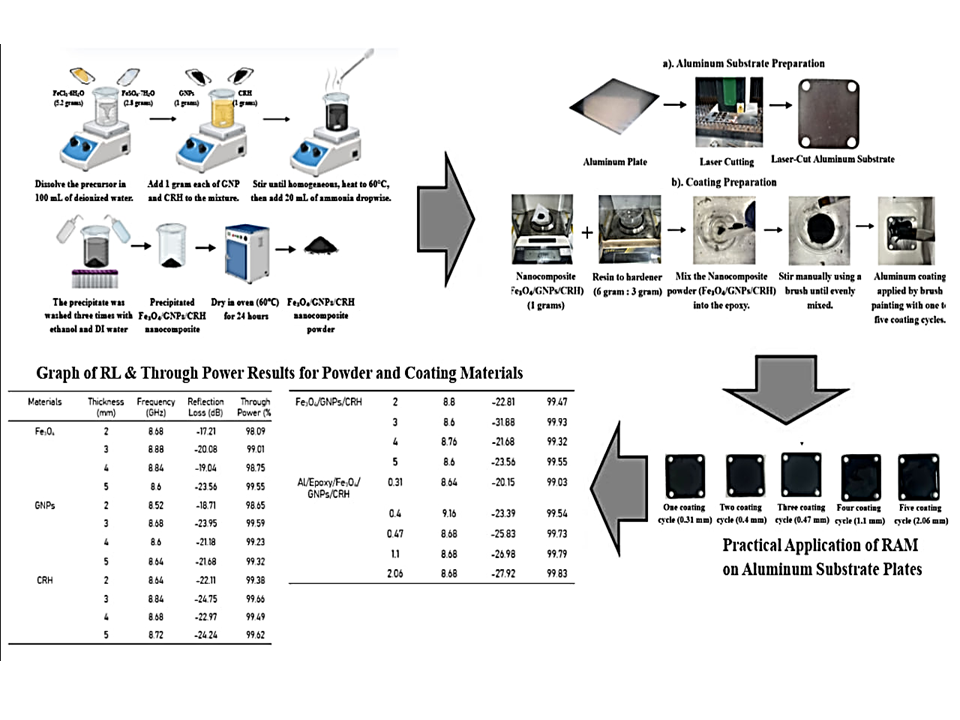
In this study, an Fe₃O₄/graphene nanoplatelet/carbonized rice husk (Fe₃O₄/GNPs/CRH) nanocomposite was synthesized via in situ co-precipitation and used as an epoxy coating on an aluminum substrate. The carbonization of rice husk (CRH) was performed by heating the husk at 800 °C for 2 h under a continuous N₂ atmosphere. FTIR spectroscopy was used to identify the characteristic functional groups of Fe₃O₄, GNPs, CRH, and the resulting nanocomposite. The coating thickness and surface wettability were evaluated through cross-sectional thickness measurements and water contact angle measurements, respectively. Microwave absorption performance was evaluated using a vector network analyzer (VNA) in the X-band frequency range of 8–12 GHz. The Fe₃O₄/GNPs/CRH nanocomposite exhibited a maximum reflection loss (RL) of −31.88 dB at 8.60 GHz with a thickness of 3 mm and a through power of 99.93%, whereas Fe₃O₄, GNPs, and CRH exhibited maximum RL values of −23.56, −23.95, and −24.75 dB, respectively. For the epoxy coating on aluminum, the thickness increased from 0.311 to 2.066 mm as the number of coating cycles increased. The microwave absorption performance improved with increasing coating thickness, reaching a maximum RL of −27.92 dB at 8.68 GHz for a coating thickness of 2.066 mm, with a through power of 99.83%. Water contact angle measurements showed hydrophilic behavior for all coated samples, with contact angles ranging from 51.43° to 59.49°, compared with 75.38° for uncoated aluminum.
References
[1] Yilmaz Atay, H., & İçin, Ö. 2020. Manufacturing radar-absorbing composite materials by using magnetic Co-doped zinc oxide particles synthesized by Sol-Gel. J. Compos. Mater. 54(26). 4059–4066. doi: https://doi.org/10.1177/0021998320927754
[2] Kim, S.H., Lee, S.Y., Zhang, Y., Park, S.J., & Gu, J. 2023. Carbon-based radar-absorbing materials toward stealth technologies. Adv. Sci. 10(32). 1–22. doi: https://doi.org/10.1002/advs.202303104
[3] Ruiz-Perez, F., López-Estrada, S.M., Tolentino-Hernández, R. V., & Caballero-Briones, F. 2022. Carbon-based radar absorbing materials: A critical review. J. Sci. Adv. Mater. Devices. 7(3). 100454. doi: https://doi.org/10.1016/j.jsamd.2022.100454
[4] Mohammed, O.K., Tahir, A.S., & Al-Tumah, W.A.G. 2024. Effect of radar-absorbing materials on radar cross-section reduction of complex targets. Iraqi J. Appl. Phys. 20(2 A). 209–214. https://doi.org/10.2025/cmj74137
[5] Qu, S., Wu, G., Fang, J., Zang, D., Xing, H., Wang, L., & Wu, H. 2017. Dielectric and magnetic loss behavior of nano-oxides. Dalam Spectroscopic Methods for Nanomaterials Characterization (Thomas, S., dkk., Eds.). Elsevier. pp. 259–277. doi: https://doi.org/10.1016/B978-0-323-46140-5.00011-X
[6] Sun, X., He, J., Li, G., Tang, J., Wang, T., Guo, Y., & Xue, H. 2013. Laminated magnetic graphene with enhanced electromagnetic wave absorption properties. J. Mater. Chem. C. 1(4). 765–777. doi: https://doi.org/10.1039/C2TC00159D
[7] Collado, I., Jiménez-Suárez, A., Vázquez-López, A., del Rosario, G., & Prolongo, S.G. 2024. Ultrasonication influence on the morphological characteristics of graphene nanoplatelet nanocomposites and their electrical and electromagnetic interference shielding behavior. Polymers (Basel). 16(8).1068. doi: https://doi.org/10.3390/polym16081068
[8] Wang, X., Xing, X., Zhu, H., Li, J., & Liu, T. 2023. State of the art and prospects of Fe3O4/carbon microwave absorbing composites from the dimension and structure perspective. Adv. Colloid Interface Sci. 318. 102960. doi: https://doi.org/10.1016/j.cis.2023.102960
[9] Zhang, W., Zheng, Y., Zhang, X., Zhu, Q., Tian, L., Wu, H., Yan, H., & Qi, S. 2019. Structure-microwave absorption performance correlations of GNPs/ZnO nanocomposite absorber: Synthesis, characterization, and mechanism investigation. Ceram. Int. 45(10). 13376–13384. doi: https://doi.org/10.1016/j.ceramint.2019.04.033.
[10] Amalia, G.R., Hardiansyah, A., Rasendriya, A.B., Rahmadtullah, I., Setiono, A., & Murniati, R. 2025. Synthesis and characterization of titanium dioxide/graphene nanoplatelets nanocomposites via planetary ball milling for military radar absorbing materials. Indones. J. Chem. Stud. 4(1). 22–27. doi: https://doi.org/10.55749/ijcs.v4i1.67
[11] Yavuz, C.T., Mayo, J.T., Yu, W.W., Prakash, A., Falkner, J.C., Yean, S., Cong, L., Shipley, H.J., Kan, A., Tomson, M. and Natelson, D. 2006. Low-field magnetic separation of monodisperse Fe3O4 nanocrystals. Science. 314(5801). 964–967. doi: https://doi.org/10.1126/SCIENCE.1131475
[12] Li, B., Weng, X., Sun, X., Zhang, Y., Lv, X., & Gu, G. 2018. Facile synthesis of Fe3O4/reduced graphene oxide/polyvinyl pyrrolidone ternary composites and their enhanced microwave absorbing properties. J. Saudi Chem. Soc. 22(8). 979–984. doi: https://doi.org/10.1016/j.jscs.2018.02.006
[13] Li, C.Q., Xu, W., Ding, R.C., Shen, X., Chen, Z., Li, M.D., & Wang, G.S. 2019. Tunable High-Performance Microwave Absorption and Shielding by Three Constituent Phases Between rGO and Fe3O4@SiO2 Nanochains. Front. Chem. 7(November). 1–9. doi: https://doi.org/10.3389/fchem.2019.00711
[14] He, Y., Hao, S., Chen, Y., Shi, S., Tian, J., & Yang, C. 2025. Biomass-derived porous carbon-based composites for electromagnetic wave absorption. Adv. Nanocomposites. 2(August). 162–184. doi: https://doi.org/10.1016/j.adna.2025.08.002
[15] Fang, J., Shang, Y., Chen, Z., Wei, W., Hu, Y., Yue, X., & Jiang, Z. 2017. Rice husk-based hierarchically porous carbon and magnetic particle composites for highly efficient electromagnetic wave attenuation. J. Mater. Chem. C. 5(19). 4695–4705. doi: https://doi.org/10.1039/C7TC00987A
[16] Yahaya, N.Z., Salim, S.R., Mustafa, I.S., Razak, N.N.A., & Zahid, L. 2018. Effects of grain sizes on rice husk ash composite as microwave absorber. J. Phys. Conf. Ser. 1083(1).012051. doi: https://doi.org/10.1088/1742-6596/1083/1/012051
[17] Melvin, G.J.H., Wang, Z., & Ni, Q.Q. 2019. Electromagnetic wave absorption performance of carbonized rice husk obtained at various temperatures. Glob. Challenges. 3(11). 1–5. doi: https://doi.org/10.1002/gch2.201900045
[18] Jin, Y., Yu, H., Wang, Y., Wang, L., & Nan, B. 2024. Recent progress in electromagnetic wave absorption coatings: from design principles to applications. Coatings. 14(5). 607 doi: https://doi.org/10.3390/coatings14050607
[19] Zhu, L., Li, N., & Childs, P.R.N. 2018. Light-weighting in aerospace component and system design. Propuls. Power Res. 7(2). 103–119. doi: https://doi.org/10.1016/j.jppr.2018.04.001
[20] Richter, R., Vagias, I., Sani-Taiariol, T., Gomes, N.A.S., Bacci, D., & Baldan, M.R. 2025. Adaptive RF stealth for next-generation long-range cruise missiles through interdisciplinary integration of MnZn ferrite/epoxy RAM and sea-surface multipath null exploitation. Def. Technol. 59. 149-165. doi: https://doi.org/10.1016/j.dt.2025.11.010
[21] Barik, R., Pradhan, M., Mahapatra, A., & Nath, G. 2026. Graphene nanoplatelet-reinforced luffa cylindrica fiber/epoxy composites for X-band microwave absorption. Compos. Commun. 61. 102682. doi: https://doi.org/10.1016/j.coco.2025.102682
[22] Barik, R. & Nath, G. 2026. Graphene nanoplatelet/α-Fe2O3 integrated carbon fiber-based composites for electromagnetic interference shielding and microwave absorption. Mater. Sci. Semicond. Process. 202. 110157. doi: https://doi.org/10.1016/j.mssp.2025.110157
[23] Negi, P. & Kumar, A. 2022. Biomass-Derived Activated Carbon/Epoxy Composite as Microwave Absorbing Material. J. Electron. Mater. 51(6). 2918–2925. doi: https://doi.org/10.1007/s11664-022-09558-y
[24] Chitraningrum, N., Marlina, R., Arundina, R.Y., Suryani Togatorop, E.R., Sulistyaningsih, Arisesa, H., Budiman, I., Daud, P., & Hamzah, M. 2022. Microwave absorption properties of porous activated carbon-based palm oil empty fruit bunch. AIP Adv. 12(11). 35083–35093. doi: https://doi.org/10.1063/5.0128960
[25] Cheng, Y.L., Dai, J.M., Zhu, X.B., Wu, D.J., Yang, Z.R., & Sun, Y.P. 2009. Enhanced microwave absorption properties of intrinsically core/shell structured La 0.6Sr 0.4 nanoparticles. Nanoscale Res. Lett. 4(10). 1153–1158. doi: http://dx.doi.org/10.1007/s11671-009-9374-y
[26] Mesa, S., Castro-Ladino, J.R., Amaya, S.L., Manrique, C., Echavarría, A., Hoyos-Ayala, D.A., & Uran, L. 2025. Comprehensive Characterization of Carbonaceous Material Derived from Rice Husk Pyrolysis and Its Potential for CO2 Adsorption. Materials (Basel). 18(22). 1–16. doi: https://doi.org/10.3390/ma18225151
[27] Yang, X., Zhou, T., Ren, B., Shi, Z., & Hursthouse, A. 2017. Synthesis, Characterization, and Adsorptive Properties of Fe3O4/GO Nanocomposites for Antimony Removal. J. Anal. Methods Chem. 2017. 3012364. doi: https://doi.org/10.1155/2017/3012364
[28] Prato, R.A., Van Vught, V., Eggermont, S., Pozo, G., Marin, P., Fransaer, J., & Dominguez-Benetton, X. 2019. Gas Diffusion Electrodes on the Electrosynthesis of Controllable Iron Oxide Nanoparticles. Sci. Rep. 9(1). 1–11. doi: https://doi.org/10.1038/s41598-019-51185-x
[29] Wang, F. & Drzal, L.T. 2018. Development of stiff, tough and conductive composites by the addition of graphene nanoplatelets to polyethersulfone/epoxy composites. Materials (Basel). 11(11). 2137. doi: https://doi.org/10.3390/ma11112137
[30] Daffalla, S.B., Mukhtar, H., & Shaharun, M.S. 2020. Preparation and characterization of rice husk adsorbents for phenol removal from aqueous systems. PLoS One. 15(12). e0243540.doi: https://doi.org/10.1371/journal.pone.0243540
[31] Bakdash, R.S., Aljundi, I.H., Basheer, C., & Abdulazeez, I. 2020. Rice husk-derived aminated silica for the efficient adsorption of different gases. Sci. Rep. 10(1). 1–12. doi: https://doi.org/10.1038/s41598-020-76460-0
[32] Akerboom, S., Kamperman, M., & Leermakers, F.A.M. 2016. Three-gradient regular solution model for simple liquids wetting complex surface topologies. Beilstein J. Nanotechnol. 7(1). 1377–1396. doi: https://doi.org/10.3762/bjnano.7.129
[33] Li, Y., Wang, G., Guo, Y., Fang, N., Li, J., Li, Z., & Li, J. 2024. Preparation of cardanol-based curing agent for underwater drainage pipeline repairs. E-Polymers. 24(1). 20230190.doi: https://doi.org/10.1515/epoly-2023-0190
[34] Alam, K., Jo, Y.Y., Park, C.K., & Cho, H. 2020. Synthesis of graphene oxide using atmospheric plasma for prospective biological applications. Int. J. Nanomedicine. 15. 5813–5824. doi: https://doi.org/10.2147/IJN.S254860
[35] Abakah, R.R., Huang, F., Hu, Q., Wang, Y., & Jing, L. 2021. Comparative study of corrosion properties of different graphene nanoplate/epoxy composite coatings for enhanced surface barrier protection. Coatings. 11(3). 1–18. doi: https://doi.org/10.3390/coatings11030285
[36] Ji, W.G., Hu, J.M., Liu, L., Zhang, J.Q., & Cao, C.N. 2006. Water uptake of epoxy coatings modified with γ-APS silane monomer. Prog. Org. Coatings. 57(4). 439–443. doi: https://doi.org/10.1016/j.porgcoat.2006.09.025
[37] Dandan Doganci, M. & Sevinç, H. 2023. Investigation of superhydrophobic and anticorrosive epoxy films with al2o3 nanoparticles on different surfaces. ACS Omega. 8(24). 21559–21570. doi: https://doi.org/10.1021/acsomega.3c00729
[38] Elmahaishi, M.F., Azis, R.S., Ismail, I., Abbas, Z., Matori, K.A., Muhammad, F.D., Saat, N.K., Nazlan, R., Ibrahim, I.R., Abdullah, N.H., & Mokhtar, N. 2021. Structural, electromagnetic and microwave properties of magnetite extracted from mill scale waste via conventional ball milling and mechanical alloying techniques. Materials (Basel). 14(22). 7075. doi: https://doi.org/10.3390/ma14227075
[39] Dua, M., Zhang, Q., & Mertiny, P. 2023. Microwave heating of graphene nanoplatelet polymer composites: Experimental and finite element study. Polym. Compos. 44(8). 4924–4936. doi: https://doi.org/10.1002/pc.27460
[40] Yan, L., Li, Y., Tong, S., Zhang, K., & Xiang, J. 2024. Controllable surface functionalization of rice husk-derived porous carbon by atomic layer deposition for highly-efficient microwave absorption. Vacuum. 224. 113199. doi: https://doi.org/10.1016/j.vacuum.2024.113199
[41] Shi, Y., Yin, Y., Zhang, Y., Hu, Y., & Liu, W. 2019. Preparation and Microwave Absorption Properties of C@Fe₃O₄ Magnetic Composite Microspheres. Materials. 12(15). 2404. doi: https://doi.org/10.3390/ma12152404
[42] Kavoosi, V. & Masoudpanah, S.M. 2025. PVP-assisted MOF-derived Fe3O4/C powders for microwave absorption applications. Heliyon. 11(1). e41202. doi: https://doi.org/10.1016/j.heliyon.2024.e41202
[43] Xiang, Z., Song, Y., Xiong, J., Pan, Z., Wang, X., Liu, L., Liu, R., Yang, H., & Lu, W. 2019. Enhanced electromagnetic wave absorption of nanoporous Fe3O4 @ carbon composites derived from metal-organic frameworks. Carbon N. Y. 142. 20–31. doi: https://doi.org/10.1016/j.carbon.2018.10.014
[44] Gao, S., An, Q., Xiao, Z., Zhai, S., & Shi, Z. 2018. Significant promotion of porous architecture and magnetic Fe3O4 NPs inside honeycomb-like carbonaceous composites for enhanced microwave absorption. RSC Adv. 8(34). 19011–19023. doi: https://doi.org/10.1039/c8ra00913a
Downloads
Published
How to Cite
Issue
Section
License
Copyright (c) 2026 Indonesian Journal of Chemical Studies

This work is licensed under a Creative Commons Attribution-ShareAlike 4.0 International License.