Bismuth Oxide-Based Photocatalytic Nanoplatforms for Cancer Theranostics - Advances, Mechanisms, and Clinical Prospects
DOI:
https://doi.org/10.55749/ijcs.v5i1.137Keywords:
Bi₂O₃, Diagnostic, Nanoparticle, Photothermal, Photodynamic, ROSAbstract
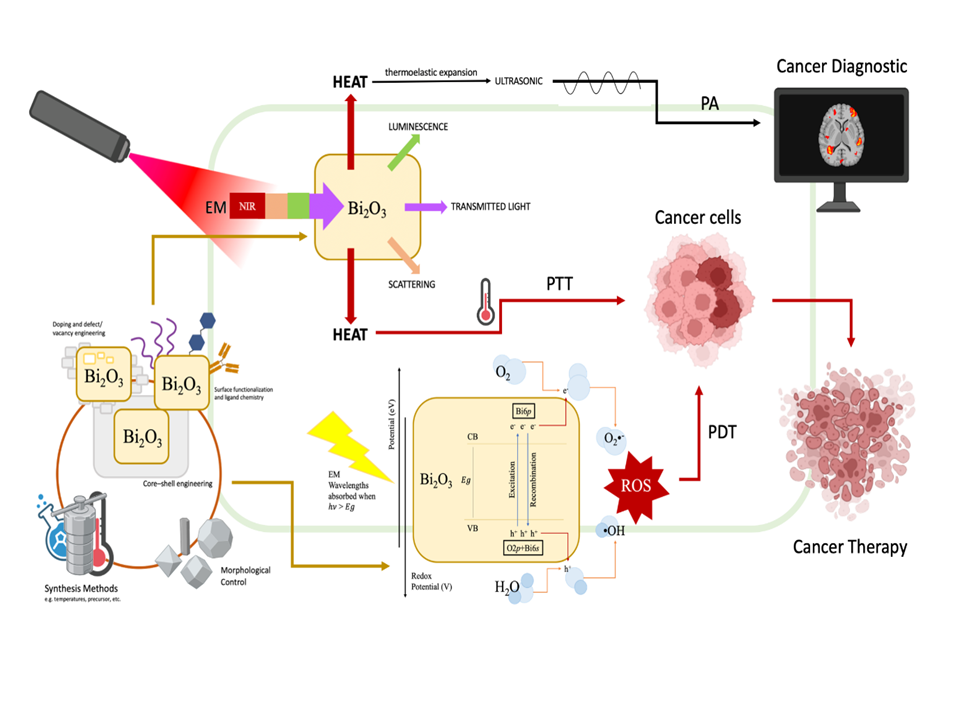
The growing demand for precise, minimally invasive, and image-guided cancer management has accelerated the development of multifunctional theranostic platforms capable of unifying diagnosis and therapy. Among emerging inorganic nanomaterials, bismuth oxide (Bi2O3) has gained significant attention due to its high atomic number, strong X-ray attenuation, tunable semiconductor band structure, and intrinsically favorable biocompatibility. This review provides a synthesis of advances in Bi2O3-based photocatalytic nanoplatforms for cancer theranostics. This article discusses how phase control, defect engineering, doping, and heterojunction construction enable enhanced ROS generation, improved charge separation, broadened optical absorption, and synergistic radiosensitization. These physicochemical features underpin a wide range of theranostic applications, including CT, photoacoustic, and multimodal imaging (photodynamic-, sonodynamic-, and photothermal-type therapies), radiotherapy enhancement; controlled chemotherapy delivery; and emerging immunomodulatory strategies. State-of-the-art designs increasingly integrate hierarchical architectures, oxygen-vacancy engineering, NIR-responsive components, and tumor microenvironment–activated functionalities to achieve intelligent, multi-stimuli cancer treatment. Despite their promise, key translational challenges persist, particularly relating to long-term biodistribution, clearance, standardized manufacturing, and regulatory validation. By consolidating mechanistic insights and engineering principles, this review outlines design guidelines for the rational development of clinically viable Bi2O3-based nanoplatforms and highlights their potential to bridge diagnostic imaging with personalized, multi-modal cancer therapy.
References
[1] American Cancer Society. 2024. Global Cancer Facts and Figures.
[2] Imtiaz, S., Ferdous, U.T., Nizela, A., Hasan, A., Shakoor, A., Zia, A.W. and Uddin, S. 2025. Mechanistic study of cancer drug delivery: Current techniques, limitations, and future prospects. Eur. J. Med. Chem. 290. 117535. Doi: https://doi.org/10.1016/j.ejmech.2025.117535
[3] Zafar, A., Khatoon, S., Khan, M.J., Abu, J. and Naeem, A. 2025. Advancements and limitations in traditional anti-cancer therapies: A comprehensive review of surgery, chemotherapy, radiation therapy, and hormonal therapy. Discov. Oncol. 16(1). 607. Doi: https://doi.org/10.1007/s12672-025-02198-8
[4] Shah, S. and D'Souza, G.G.M. 2025. Modeling tumor microenvironment complexity in vitro: Spheroids as physiologically relevant tumor models and strategies for their analysis. Cells. 14(10). 732. Doi: https://doi.org/10.3390/cells14100732
[5] Sergeeva, O.V., Luo, L. and Guiseppi-Elie, A. 2025. Cancer theragnostics: Closing the loop for advanced personalized cancer treatment through the platform integration of therapeutics and diagnostics. Front. Bioeng. Biotechnol. 12. 1499474. Doi: https://doi.org/10.3389/fbioe.2024.1499474
[6] Mousavi-Kiasary, S.M.S., S.M.S., Senabreh, A., Zandi, A., Pena, R., Cruz, F., Adibi, A. and Hooshmand, N. 2025. Synergistic cancer therapies enhanced by nanoparticles: Advancing nanomedicine through multimodal strategies. Pharmaceutics. 17(6). 682. Doi: https://doi.org/10.3390/pharmaceutics17060682
[7] Mutreja, I., Maalej, N., Kaushik, A., Kumar, D. and Raja, A. 2023. High atomic number nanoparticles to enhance spectral CT imaging aspects. Mater. Adv. 4(8). 3967–3988. Doi: https://doi.org/10.1039/D3MA00231D
[8] Huang, S.D. 2016. Bismuth-based nanoparticles for CT imaging. Des. Appl. Nanoparticles Biomed. Imaging. 429-444. Doi: https://doi.org/10.1007/978-3-319-42169-8_20
[9] Yang, C., Guo, C., Guo, W., Zhao, X., Liu, S. and Han, X. 2018. Multifunctional bismuth nanoparticles as theranostic agent for PA/CT imaging and NIR laser-driven photothermal therapy. ACS Appl. Nano Mater. 1(2). 820–830. Doi: https://doi.org/10.1021/acsanm.7b00255
[10] Astuti, Y., Amri, D., Widodo, D.S., Widiyandari, H., Balgis, R. and Ogi, T. 2020. Effect of fuels on the physicochemical properties and photocatalytic activity of bismuth oxide synthesized using solution combustion method. Int. J. Technol. 11(1). 26–36. Doi: https://doi.org/10.14716/ijtech.v11i1.3342
[11] Murthy, R.K., Shivanna, M., Ahamed, N.N., Bhoomika, V., Ravikumar, C.R. and Murthy, H.A. 2024. Photocatalytic and electrochemical sensor study of combustion synthesized bismuth oxide (Bi₂O₃) nanoparticles using lemon and urea fuels. Mater. Sci. Eng. B. 307. 117487. Doi: https://doi.org/10.1016/j.mseb.2024.117487
[12] Chen, L., Zhang, J., Xu, L., Zhu, L., Jing, J., Feng, Y., Wang, Z., Liu, P., Sun, W., Liu, X. and Li, Y. 2022. Composition tunability of semiconductor radiosensitizers for low-dose X-ray induced photodynamic therapy. J. Nanobiotechnol. 20(1). 293. Doi: https://doi.org/10.1186/s12951-022-01494-7
[13] Sharaf, I.M., Koubisy, M.S.I., Alkallas, F.H., Trabelsi, A.B.G. and Aboraia, A.M. 2025. Tailoring β-Bi₂O₃ nanoparticles via Mg doping for superior photocatalytic activity and hydrogen evolution. Catalysts. 15(6). Doi: https://doi.org/10.3390/catal15060519
[14] Huang, H., He, L., Zhou, W., Qu, G., Wang, J., Yang, N., Gao, J., Chen, T., Chu, P.K. and Yu, X.F. 2018. Stable black phosphorus/Bi2O3 heterostructures for synergistic cancer radiotherapy. Biomaterials. 171. 12-22. Doi: https://doi.org/10.1016/j.biomaterials.2018.04.022
[15] Xiao, F., Liu, Y., Su, Y., He, X., Lu, L., Zhan, M., Wen, L., Dai, Y. and Liu, B. 2024. Biodegradable poly(amino acid)-bismuth nanotheranostic agents for CT/MR imaging and photothermal-chemodynamic synergistic therapy. Chem Bio Eng. 1(5). 448–460. Doi: https://doi.org/10.1021/cbe.4c00078
[16] Zhang, X., Gao, F., Dai, Y., Wang, M. and Liu, J. 2025. Safe-by-design strategies towards bismuth-based nanomaterials in tumor diagnosis and therapy. Nano Today. 62. 102714. Doi: https://doi.org/10.1016/j.nantod.2025.102714
[17] Amika, Kumar, R., Sharma and Sindhu, M. 2023. Structural and morphological properties of bismuth oxide nanostructured materials. AIP Conf. Proc. 2008(1). 020056. Doi: https://doi.org/10.1063/5.0162786
[18] Bartoli, M., Jagdale, P. and Tagliaferro, A. 2020. A short review on biomedical applications of nanostructured bismuth oxide and related nanomaterials. Materials. 13(22). 1–17. Doi: https://doi.org/10.3390/ma13225234
[19] Utami, B.A., Sutanto, H., Hidayanto, E. and Alkian, I. 2022. Recent advances in doped Bi₂O₃ and its photocatalytic activity: A review. Int. J. Res. Rev. 9(1). 216–230. Doi: https://doi.org/10.52403/ijrr.20220128
[20] Malligavathy, M. and Pathinettam Padiyan, D. 2021. Role of pH in the hydrothermal synthesis of phase pure alpha Bi₂O₃ nanoparticles and its structural characterization. Adv. Mater. Proc. 2(1). 51–55. Doi: https://doi.org/10.5185/amp.2017/112
[21] Seswai, K.S., Makola, L.C., Mabuba, N. and Dlamini, L.N. 2024. Fabrication of a hyphenated S-scheme and Schottky-junction photocatalyst based on a ternary TiNbCTx@α-Bi₂O₃/ZnSe heterostructure with enhanced optical and photoelectrochemical properties. Surf. Interfaces. 51. 104766. Doi: https://doi.org/10.1016/j.surfin.2024.104766
[22] Sohail, A., Aalim, M., Ahmad, R., Mir, A., Majeed, A., Shah, M.A. and Majid, K. 2024. Enhanced photocatalytic performance of β-Bi₂O₃ nanospheres under visible light irradiation. Springer Proc. Mater. 27. 293–297. Doi: https://doi.org/10.1007/978-981-99-4878-9_41
[23] Iyyapushpam, S., Nishanthi, S.T. and Padiyan, D.P. 2014. Enhanced photocatalytic degradation of methyl orange by γ-Bi₂O₃ and its kinetics. J. Alloys Compd. 601. 85–87. Doi: https://doi.org/10.1016/j.jallcom.2014.02.142
[24] Yan, Q., Xie, X., Liu, Y., Wang, S., Zhang, M., Chen, Y. and Si, Y. 2019. Constructing a new Z-scheme multi-heterojunction photocatalysts Ag–AgI/BiOI–Bi₂O₃ with enhanced photocatalytic activity. J. Hazard. Mater. 371. 304–315. Doi: https://doi.org/10.1016/j.jhazmat.2019.03.031
[25] Sudrajat, H. and Sujaridworakun, P. 2017. Low-temperature synthesis of δ-Bi₂O₃ hierarchical nanostructures composed of ultrathin nanosheets for efficient photocatalysis. Mater. Des. 130. 501–511. Doi: https://doi.org/10.1016/j.matdes.2017.05.087
[26] Chen, Q. and Wang, H. 2020. Tunable optical linear and nonlinear, magnetic and Faraday rotation properties: Comparison of ZnO-based DMS alloys in diamagnetic solid matrix. J. Alloys Compd. 846. 156394. Doi: https://doi.org/10.1016/j.jallcom.2020.156394
[27] Cadenbach, T., Loyola-Plúa, M.I., Quijano Carrasco, F., Benitez, M.J., Debut, A. and Vizuete, K. 2025. Controlled formation of α- and β-Bi₂O₃ with tunable morphologies for visible-light-driven photocatalysis. Molecules. 30(15). Doi: https://doi.org/10.3390/molecules30153190
[28] Awater, R.H. and Dorenbos, P. 2017. The Bi³⁺ 6s and 6p electron binding energies in relation to the chemical environment of inorganic compounds. J. Lumin. 184. 221–231. Doi: https://doi.org/10.1016/j.jlumin.2016.12.021
[29] Mane, V., Dake, D., Raskar, N., Sonpir, R., Stathatos, E. and Dole, B. 2024. A review on Bi₂O₃ nanomaterial for photocatalytic and antibacterial applications. Chem. Phys. Impact. 8. 100517. Doi: https://doi.org/10.1016/j.chphi.2024.100517
[30] Prabhakar Vattikuti, S.V., Zeng, J., Ramaraghavulu, R., Shim, J., Mauger, A. and Julien, C.M. 2023. High-throughput strategies for the design, discovery, and analysis of bismuth-based photocatalysts. Int. J. Mol. Sci. 24(1). 663. Doi: https://doi.org/10.3390/ijms24010663
[31] Huang, X., Zha, F., Zou, J., Li, Y., Wang, F. and Chen, X. 2022. Photoacoustic imaging-guided synergistic photothermal/radiotherapy using plasmonic Bi/Bi₂O₃−x nanoparticles. Adv. Funct. Mater. 32(23). 2113353. Doi: https://doi.org/10.1002/adfm.202113353
[32] Chowdhury, A.P., Anantharaju, K.S., Keshavamurthy, K., Swain, S. and Uma, B. 2025. A mini-review on Z- and S-scheme heterojunction bismuth-based photocatalysts towards H₂ production, CO₂ reduction, and pollutant degradation. Next Mater. 8. 100918. Doi: https://doi.org/10.1016/j.nxmate.2025.100918
[33] Azimizonuzi, H., Ghayourvahdat, A., Ahmed, M.H., Kareem, R.A., Zrzor, A.J., Mansoor, A.S., Athab, Z.H. and Kalavi, S. 2025. A state-of-the-art review of the recent advances of theranostic liposome hybrid nanoparticles in cancer treatment and diagnosis. Cancer Cell Int. 25(1). 26. Doi: https://doi.org/10.1186/s12935-024-03610-z
[34] Gonçalves, Â., Matias, M., Salvador, J.A.R. and Silvestre, S. 2024. Bioactive bismuth compounds: Is their toxicity a barrier to therapeutic use? Int. J. Mol. Sci. 25(3). 1600. Doi: https://doi.org/10.3390/ijms25031600
[35] Dhanasekarana, E., Sivakumarb, N. and Sriharanc, N. 2022. Enhanced photocatalytic degradation of Gd-doped Bi₂O₃ for selective dyes under UV light irradiation. J. Optoelectron. Biomed. Mater. 14(3). 77–87. Doi: https://doi.org/10.15251/jobm.2022.143.77
[36] Ganapathy, D., Shivalingam, C., Shanmugam, R., Sundramoorthy, A.K., Murthykumar, K., Pitchiah, S., Sekaran, S. and Ramachandran, S.K. 2022. Recent breakthrough of bismuth-based nanostructured materials for multimodal theranostic applications. J. Nanomater. 2022(1). 4944320. Doi: https://doi.org/10.1155/2022/4944320
[37] Alex, J. and Mathew, T.V. 2023. Surface modification of Bi₂O₃ nanoparticles with biotinylated β-cyclodextrin as a biocompatible therapeutic agent for anticancer and antimicrobial applications. Molecules. 28(8). 3604 Doi: https://doi.org/10.3390/molecules28083604
[38] Khalili, Z., Motakef Kazemi, N., Jafari Azar, Z., Mosavi, Z. and Hasanzadeh, M. 2024. Fabrication and characterization of a Bi₂O₃-modified chitosan@ZIF-8 nanocomposite for enhanced drug loading-releasing efficacy. Int. J. Biol. Macromol. 263. 130295. Doi: https://doi.org/10.1016/j.ijbiomac.2024.130295
[39] Sikora, P., El-Khayatt, A.M., Saudi, H.A., Chung, S.Y., Stephan, D. and Abd Elrahman, M. 2021. Evaluation of the effects of bismuth oxide (Bi₂O₃) micro- and nanoparticles on the mechanical, microstructural and γ-ray/neutron shielding properties of Portland cement pastes. Constr. Build. Mater. 284. 122758. Doi: https://doi.org/10.1016/j.conbuildmat.2021.122758
[40] Ruiz-Castillo, A.L., Hinojosa-Reyes, M., Camposeco-Solis, R. and Ruiz, F. 2022. Photocatalytic activity of Bi₂O₃/BiOCl heterojunctions under UV and visible light illumination for degradation of caffeine. Top. Catal. 65. 1071–1087. Doi: https://doi.org/10.1007/s11244-022-01644-z
[41] Gandhi, A.C., Cheng, C.L. and Wu, S.Y. 2020. Structural and enhanced optical properties of stabilized γ-Bi₂O₃ nanoparticles: Effect of oxygen ion vacancies. Nanomaterials. 10(6). 1023. Doi: https://doi.org/10.3390/nano10061023
[42] Cornei, N., Tancret, N., Abraham, F. and Mentré, O. 2006. New ε-Bi₂O₃ metastable polymorph. Inorg. Chem. 45(12). 4886–4888. Doi: https://doi.org/10.1021/ic0605221
[43] Ali, F.S., Ragamathunnisa, M., Al Marzouqi, F., Jahangir, A.R.M., Ayeshamariam, A. and Kaviyarasu, K. 2019. Synthesis and characterization of Bi₂O₃ nanoparticles and photocatalytic application with methylene blue. JOBM. 13(3), 95-106. Doi: https://doi.org/10.21203/rs.3.rs-577935/v1
[44] Duan, X., Wang, P., He, L., He, Z., Wang, S., Yang, F., Gao, C., Ren, W., Lin, J., Chen, T. and Xu, C. 2024. Peptide-functionalized inorganic oxide nanomaterials for solid cancer imaging and therapy. Adv. Mater. 36(37). 2311548. Doi: https://doi.org/10.1002/adma.202311548
[45] Wu, Y.C., Chiang, Y.C., Huang, C.Y., Wang, S.F. and Yang, H.Y. 2013. Morphology-controllable Bi₂O₃ crystals through an aqueous precipitation method and their photocatalytic performance. Dyes Pigments. 99(1). 25–30. Doi: https://doi.org/10.1016/j.dyepig.2013.02.006
[46] Al-Ghamdi, A.A., Al-Turki, Y., Aal, N.A., Yakuphanoglu, F. and El-Tantawy, F. 2017. Microwave-assisted hydrothermal synthesis of monoclinic bismuth trioxide nanorods: Optical and photocatalytic properties. J. Mater. Sci. Mater. Electron. 28(12). 8684–8693. Doi: https://doi.org/10.1007/s10854-017-6593-3
[47] Kong, S., Zhang, T., He, Y., Zhou, Y., Yan, G. and Huang, M. 2025. Porous Ce-doped Bi₂O₃ pollen biomorphic photocatalyst with high specific surface area and oxygen vacancies for efficient degradation of tetracycline. J. Rare Earths. 44(3). 776-790. Doi: https://doi.org/10.1016/j.jre.2025.03.032
[48] Wu, H., Kong, J., Yao, X., Zhao, C., Dong, Y. and Lu, X. 2015. Polydopamine-assisted attachment of β-cyclodextrin on porous electrospun fibers for water purification under highly basic condition. Chem. Eng. J. 270. 101–109. Doi: https://doi.org/10.1016/j.cej.2015.02.019
[49] Ghazanfari, A., Marasini, S., Yue, H., Ho, S.L., Miao, X., Ahmad, M.Y., Park, J., Jung, K.H., Liu, S., Jang, Y.J. and Chae, K.S. 2020. D-Glucuronic acid-coated ultrasmall Bi₂O₃ nanoparticles for CT imaging. J. Nanosci. Nanotechnol. 20(8). 4638–4642. Doi: https://doi.org/10.1166/jnn.2020.17817
[50] Xue, S., He, H., Fan, Q., Yu, C., Yang, K., Huang, W., Zhou, Y. and Xie, Y. 2017. La/Ce-codoped Bi₂O₃ composite photocatalysts with high photocatalytic performance in removal of high concentration dye. J. Environ. Sci. 60. 70–77. Doi: https://doi.org/10.1016/j.jes.2016.09.022
[51] Chu, Q., Ren, G. and Meng, X. 2025. Ru-doped Bi₂O₃ with rich oxygen vacancy for enhanced photocatalytic nitrogen reduction. J. Alloys Compd. 1012. 178441. Doi: https://doi.org/10.1016/j.jallcom.2024.178441
[52] Tang, T., Yin, Z., Chen, J., Zhang, S., Sheng, W., Wei, W., Xiao, Y., Shi, Q. and Cao, S. 2021. Novel p–n heterojunction Bi₂O₃/Ti³⁺-TiO₂ photocatalyst enables the complete removal of tetracyclines under visible light. Chem. Eng. J. 417. 128058. Doi: https://doi.org/10.1016/j.cej.2020.128058
[53] Yang, J., Wang, X., Yan, S., Huang, F., Xia, X., Zhao, Y., Hao, P., Cui, G. and Wang, Q. 2025. Facile construction of (Bi₂O₃/Bi₂O₂.₃₃)/TiO₂ S-scheme heterojunction by deep eutectic solvent-regulated strategy for enhanced photocatalytic tetracycline degradation. J. Alloys Compd. 1020. 179400. Doi: https://doi.org/10.1016/j.jallcom.2025.179400
[54] Wang, M., Li, C., Liu, B., Qin, W. and Xie, Y. 2023. Facile synthesis of nano-flower β-Bi₂O₃/TiO₂ heterojunction as photocatalyst for degradation of RhB. Molecules. 28(2). 882. Doi: https://doi.org/10.3390/molecules28020882
[55] Zheng, Z., Williams, G.R., Guo, H., Zheng, Y., Xiu, M., Zhang, Y., Zhang, H., Wang, K., Xia, J., Wang, Y. and Zhu, L.M. 2025. A Bi₂O₃-TiO₂ heterojunction for triple-modality cancer theranostics. Int. J. Nanomedicine. 20. 5593–5610. Doi: https://doi.org/10.2147/IJN.S511891
[56] Hoff, B.L., Cheng, G., Villalpando, G., Yuan, F., Yao, N. and Schoop, M.L. 2022. Chemically exfoliated nanosheets of β-Bi₂O₃. JPhys Mater. 5(4). Doi: https://doi.org/10.1088/2515-7639/ac92a7
[57] Zheng, F.L., Li, G.R., Ou, Y.N., Wang, Z.L., Su, C.Y. and Tong, Y.X. 2010. Synthesis of hierarchical rippled Bi₂O₃ nanobelts for supercapacitor applications. Chem. Commun. 46(27). 5021–5023. Doi: https://doi.org/10.1039/C002126A
[58] Yahyazadehfar, M., Sheikhhosseini, E., Ahmadi, S.A. and Ghazanfari, D. 2022. Microwave-assisted synthetic method of novel Bi₂O₃ nanostructure and its application as a high-performance nanocatalyst in preparing benzylidene barbituric acid derivatives. Front. Chem. 10. 951229. Doi: https://doi.org/10.3389/fchem.2022.951229
[59] Xiangying, C. and Huh, H.S. 2007. Controlled synthesis of bismuth oxo nanoscale crystals (BiOCl, Bi₁₂O₁₇Cl₂, α-Bi₂O₃, and (BiO)₂CO₃) by solution-phase methods. J. Solid State Chem. 180(9). 2510–2516. Doi: https://doi.org/10.1016/j.jssc.2007.06.030
[60] Johnson, P.M., Bret, B.P.J., Rivas, J.G., Kelly, J.J. and Lagendijk, A. 2002. Anisotropic diffusion of light in a strongly scattering material. Phys. Rev. Lett. 89(24). 243901. Doi: https://doi.org/10.1103/PhysRevLett.89.243901
[61] Yang, Z., Shi, C., Cheng, D., Wang, Y., Xing, Y., Du, F., Wu, F., Jin, Y., Dong, Y. and Li, M. 2022. Biomimetic nanomaterial-facilitated oxygen generation strategies for enhancing tumour treatment outcomes. Front. Bioeng. Biotechnol. 10. 1007960. Doi: https://doi.org/10.3389/fbioe.2022.1007960
[62] Yan, Y., Chang, K., Ni, T. and Li, K. 2019. L-Cysteine-assisted synthesis of Bi₂S₃ hollow sphere with enhanced near-infrared light harvesting for photothermal conversion and drug delivery. Mater. Lett. 245. 158–161. Doi: https://doi.org/10.1016/j.matlet.2019.02.104
[63] Liu, J., Shi, J. and Deng, H. 2023. Current status of research on BiOX-based heterojunction photocatalytic systems: Synthesis methods, photocatalytic applications and prospects. J. Environ. Chem. Eng. 11(5). 110311. Doi: https://doi.org/10.1016/j.jece.2023.110311
[64] Abdelkader, S.A., Cui, Z., Laachachi, A., Colbeau-Justin, C. and Ghazzal, M.N. 2021. Interfacial charge transfer and photocatalytic activity in a reverse-designed Bi₂O₃/TiO₂ core-shell. Front. Energy. 15(3). 732–743. Doi: https://doi.org/10.1007/s11708-021-0772-x
[65] Wang, Z., Liu, S., Wang, L., Zou, H., Wang, Z., Tang, X., Feng, W., Chong, Y., Liu, Y., Yang, B. and Zhang, H. 2020. BiVO₄@Bi₂S₃ heterojunction nanorods with enhanced charge separation efficiency for multimodal imaging and synergy therapy of tumor. ACS Appl. Bio Mater. 3(8). 5080–5092. Doi: https://doi.org/10.1021/acsabm.0c00573
[66] Zhao, H., Wang, J., Li, X., Li, Y., Li, C., Wang, X., Wang, J., Guan, S., Xu, Y., Deng, G. and Chen, Y. 2021. A biocompatible theranostic agent based on stable bismuth nanoparticles for X-ray computed tomography/magnetic resonance imaging-guided enhanced chemo/photothermal/chemodynamic therapy for tumours. J. Colloid Interface Sci. 604. 80–90. Doi: https://doi.org/10.1016/j.jcis.2021.06.174
[67] Sajjad, S., Leghari, S.A.K. and Zhang, J. 2013. Nonstoichiometric Bi₂O₃: Efficient visible light photocatalyst. RSC Adv. 3(5). 1363–1367. Doi: https://doi.org/10.1039/C2RA22239F
[68] Xu, X., Sun, Y., Fan, Z., Zhao, D., Xiong, S., Zhang, B., Zhou, S. and Liu, G. 2018. Mechanisms for ·O₂⁻ and ·OH production on flowerlike BiVO₄ photocatalysis based on electron spin resonance. Front. Chem. 6. 64. Doi: https://doi.org/10.3389/fchem.2018.00064
[69] Liu, H., Cheng, R., Dong, X., Zhu, S., Zhou, R., Yan, L., Zhang, C., Wang, Q., Gu, Z. and Zhao, Y. 2020. BiO₂−x nanosheets as radiosensitizers with catalase-like activity for hypoxia alleviation and enhancement of the radiotherapy of tumors. Inorg. Chem. 59(6). 3482–3493. Doi: https://doi.org/10.1021/acs.inorgchem.9b03280
[70] Riente, P., Fianchini, V., Llanes, P., Pericàs, M.A. and Noël, T. 2021. Shedding light on the nature of the catalytically active species in photocatalytic reactions using Bi₂O₃ semiconductor. Nat. Commun. 12(1). 625. Doi: https://doi.org/10.1038/s41467-020-20882-x
[71] Luo, T., Ni, K., Culbert, A., Lan, G., Li, Z., Jiang, X., Kaufmann, M. and Lin, W. 2020. Nanoscale metal-organic frameworks stabilize bacteriochlorins for type I and type II photodynamic therapy. J. Am. Chem. Soc. 142(16). 7334–7339. Doi: https://doi.org/10.1021/jacs.0c02129
[72] Zhen, W., Liu, Y., Jia, X., Wu, L., Wang, C. and Jiang, X. 2019. Reductive surfactant-assisted one-step fabrication of a BiOI/BiOIO₃ heterojunction biophotocatalyst for enhanced photodynamic theranostics overcoming tumor hypoxia. Nanoscale Horiz. 4(3). 720–726. Doi: https://doi.org/10.1039/C8NH00440D
[73] Fang, C., Ding, Q., Bi, T., Xu, X., Chen, J.L., Zhu, X.M. and Geng, B. 2018. Plasmonic band-tunable (Au nanocrystal)/SnO₂ core/shell hybrids for photothermal therapy. Part. Part. Syst. Charact. 35(10). 1800238. Doi: https://doi.org/10.1002/ppsc.201800238
[74] Son, S., Kim, J.H., Wang, X., Zhang, C., Yoon, S.A., Shin, J., Sharma, A., Lee, M.H., Cheng, L., Wu, J. and Kim, J.S. 2020. Multifunctional sonosensitizers in sonodynamic cancer therapy. Chem. Soc. Rev. 49(11). 3244–3261. Doi: https://doi.org/10.1039/C9CS00648F
[75] Jay-Gerin, J.P. 2020. Ultra-high dose-rate (FLASH) radiotherapy: Generation of early, transient, strongly acidic spikes in the irradiated tumor environment. Cancer Radiother. 24(4). 332–334. Doi: https://doi.org/10.1016/j.canrad.2019.11.004
[76] Aghanwa, C.I., Umoke, N.H., Adanigbo, P., Babatunde, R.O., Fafioye, A.O., Adara, R.J., Ofoka, E.A., Ezennubia, K.P., Erumiseli, O. and Ifijen, I.H. 2025. Radiotherapy-chemodynamic cancer therapy using bismuth-based nanoparticles: A synergistic approach for enhanced cancer treatment. RSC Adv. 15(40). 32956–32994. Doi: https://doi.org/10.1039/D5RA03984C
[77] Vasvani, S., Vasukutty, A., Bardhan, R., Park, I.K. and Uthaman, S. 2024. Reactive oxygen species-driven prodrug-based nanoscale carriers for transformative therapies. Biomater. Sci. 12(17). 4335–4353. Doi: https://doi.org/10.1039/D4BM00647J
[78] Li, T., Gao, M., Wu, Z., Yang, J., Mo, B., Yu, S., Gong, X., Liu, J., Wang, W., Luo, S. and Li, R. 2023. Tantalum–zirconium co-doped metal-organic frameworks sequentially sensitize radio-radiodynamic-immunotherapy for metastatic osteosarcoma. Adv. Sci. 10(10). 2206779. Doi: https://doi.org/10.1002/advs.202206779
[79] Mbugua, S.N. 2022. Targeting tumor microenvironment by metal peroxide nanoparticles in cancer therapy. Bioinorg. Chem. Appl. 2022(1). 5041399. Doi: https://doi.org/10.1155/2022/5041399
[80] Liu, J., Zhang, J., Song, K., Du, J., Wang, X., Liu, J., Li, B., Ouyang, R., Miao, Y., Sun, Y. and Li, Y. 2021. Tumor microenvironment modulation platform based on composite biodegradable bismuth–manganese radiosensitizer for inhibiting radioresistant hypoxic tumors. Small. 17(34). 2101015 Doi: https://doi.org/10.1002/smll.202101015
[81] Chen, D., Miao, B., Zhu, G., Liang, Y. and Wang, C. 2024. Controllable synthesis and biomedical applications of bismuth-based nanospheres: Enhanced photothermal therapy and CT imaging efficiency. Nanoscale. 17(4). 2281–2291. Doi: https://doi.org/10.1039/D4NR04024D
[82] Rajaee, A., Wang, S., Zhao, L., Wang, D., Liu, Y., Wang, J. and Ying, K. 2019. Multifunction bismuth gadolinium oxide nanoparticles as radiosensitizer in radiation therapy and imaging. Phys. Med. Biol. 64(19). 195007. Doi: https://doi.org/10.1088/1361-6560/ab2154
[83] Chen, G., Du, J., Gu, L., Wang, Q., Qi, Q., Li, X., Zhang, R., Yang, H., Miao, Y. and Li, Y. 2024. Metal-sensitized Au-Bi₂O₃ nanoheterojunction for immunogenic cell death-boosted sono-immuno cancer therapy. Chem. Eng. J. 482. 148953. Doi: https://doi.org/10.1016/j.cej.2024.148953
[84] Ma, S., Xie, J., Wang, L., Zhou, Z., Luo, X., Yan, J. and Ran, G. 2021. Hetero-core-shell BiNS-Fe@Fe as a potential theranostic nanoplatform for multimodal imaging-guided simultaneous photothermal-photodynamic and chemodynamic treatment. ACS Appl. Mater. Interfaces. 13(9). 10728–10740. Doi: https://doi.org/10.1021/acsami.0c21579
[85] Yang, Z., Yuan, M., Liu, B., Zhang, W., Maleki, A., Guo, B., Ma, P.A., Cheng, Z. and Lin, J. 2022. Conferring BiVO₄ nanorods with oxygen vacancies to realize enhanced sonodynamic cancer therapy. Angew. Chem. Int. Ed. 61(44). e202209484. Doi: https://doi.org/10.1002/anie.202209484
[86] Badrigilan, S., Choupani, J., Khanbabaei, H., Hoseini-Ghahfarokhi, M., Webster, T.J. and Tayebi, L. 2020. Bismuth-based nanomaterials: Recent advances in tumor targeting and synergistic cancer therapy techniques. Adv. Healthc. Mater. 9(7). 1901695. Doi: https://doi.org/10.1002/adhm.201901695
[87] Du, F., Lou, J., Jiang, R., Fang, Z., Zhao, X., Niu, Y., Zou, S., Zhang, M., Gong, A. and Wu, C. 2017. Hyaluronic acid-functionalized bismuth oxide nanoparticles for computed tomography imaging-guided radiotherapy of tumor. Int. J. Nanomedicine. 12. 5973–5992. Doi: https://doi.org/10.2147/IJN.S130455
[88] Ma, Y.C., Tang, X.F., Xu, Y.C., Jiang, W., Xin, Y.J., Zhao, W., He, X., Lu, L.G. and Zhan, M.X. 2021. Nano-enabled coordination platform of bismuth nitrate and cisplatin prodrug potentiates cancer chemoradiotherapy via DNA damage enhancement. Biomater. Sci. 9(9). 3401–3409. Doi: https://doi.org/10.1039/D1BM00157D
[89] Wang, S., Chen, W., Jiang, C. and Lu, L. 2019. Nanoscaled porphyrinic metal-organic framework for photodynamic/photothermal therapy of tumor. Electrophoresis. 40(16). 2204–2210. Doi: https://doi.org/10.1002/elps.201900005
[90] Mo, D., Pan, M., Chen, W., Liu, Q., Yu, Y., Yuan, L., Yang, Y., Deng, H., Wang, M. and Qian, Z. 2024. Sulfur vacancy-rich Bi₂S₃−x@PDA heterojunctions with light-controlled reactive oxygen species generation and elimination to combat biofilm infection and inflammation caused by drug-resistant bacteria. Adv. Funct. Mater. 34(26). 2313569. Doi: https://doi.org/10.1002/adfm.202313569
[91] Ghaffari, S.B., Sarrafzadeh, M.H., Fakhroueian, Z. and Khorramizadeh, M.R. 2019. Flower-like curcumin-loaded folic acid-conjugated ZnO-MPA-β-cyclodextrin nanostructures enhanced anticancer activity and cellular uptake of curcumin in breast cancer cells. Mater. Sci. Eng. C. 103. 109827. Doi: https://doi.org/10.1016/j.msec.2019.109827
[92] Szostak, K., Ostaszewski, P., Pulit-Prociak, J. and Banach, M. 2019. Bismuth oxide nanoparticles in drug delivery systems. Pharm. Chem. J. 53(1). 48–51. Doi: https://doi.org/10.1007/s11094-019-01954-9
Downloads
Published
How to Cite
Issue
Section
License
Copyright (c) 2026 Indonesian Journal of Chemical Studies

This work is licensed under a Creative Commons Attribution-ShareAlike 4.0 International License.