Cytotoxic Evaluation of Medicinal Plants used by Suku Anak Dalam Community in Jambi Province Using the Brine Shrimp Lethality Test
DOI:
https://doi.org/10.55749/ijcs.v5i1.146Keywords:
BSLT, Cytotoxicity, Medicinal plants, Suku Anak DalamAbstract
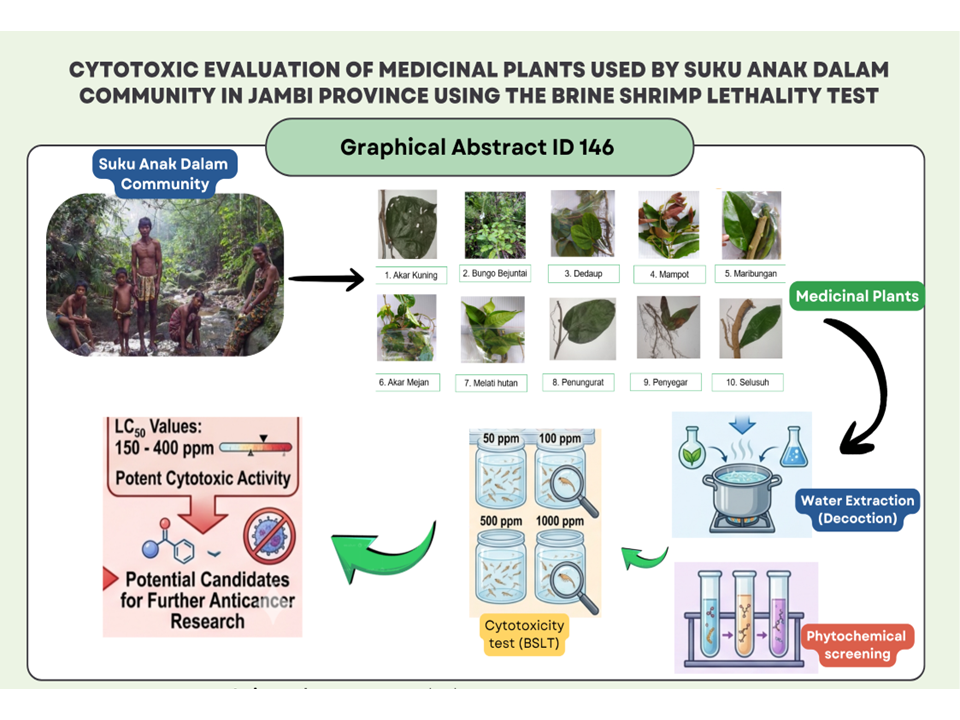
Cancer remains a major global health challenge, and the search for effective therapeutic agents continues. Natural products, including traditional medicinal plants used by the Suku Anak Dalam (SAD) community in Jambi, offer promising sources of bioactive compounds. This study investigated the cytotoxic potential of ten SAD medicinal plants extracted through a decoction method. Phytochemical screening revealed the presence of alkaloids, flavonoids, and saponins. Cytotoxicity was assessed using the Brine Shrimp Lethality Test (BSLT) at concentrations of 50, 100, 500, and 1000 ppm. All plant extracts exhibited toxic-level cytotoxicity, which correlated with their secondary metabolite profiles and their inhibitory effects on Artemia salina Leach larvae. The LC₅₀ values ranged from 150 to 400 ppm, indicating that these traditional medicinal plants possess notable cytotoxic activity. These findings support the potential of SAD ethnomedicinal plants as candidates for further investigation in anticancer research.
References
[1] Bray, F., Laversanne, M., Sung, H., Ferlay, J., Siegel, R.L., Soerjomataram, I. and Jemal, A. 2024. Global cancer statistics 2022: GLOBOCAN estimates of incidence and mortality worldwide for 36 cancers in 185 countries. CA. Cancer J. Clin. 74(3). 229-263. Doi: https://doi.org/10.3322/caac.21660
[2] Cao, W., Qin, K., Li, F. and Chen, W. 2024. Comparative study of cancer profiles between 2020 and 2022 using global cancer statistics (GLOBOCAN). J. Natl. Cancer Cent. 4(2). 128-134. Doi: https://doi.org/10.1016/j.jncc.2024.05.001
[3] T.I.A. for R. on Cancer (IARC). Global Cancer Observatory. Accessed: Dec. 11, 2025. Available: https://gco.iarc.fr/
[4] Latif, R. and Nawaz, T. 2025. Medicinal plants and human health: A comprehensive review of bioactive compounds, therapeutic effects, and applications. Phytochem. Rev. 1-44. Doi: https://doi.org/10.1007/s11101-025-10194-7
[5] Perawati, S., Sadli, N.K., Pondawinata, M., Oktaria, R., Fauziah, A.U., Khairunnisa, R.Z., Zafira, F.A. and Sagita, D. 2025. Phytochemical screening and antibacterial activity of medicinal plants used by the Suku Anak Dalam community in Jambi Province, Indonesia. Proc. Acad. Univ. Jambi. 1(2). 685-696. Doi: https://doi.org/10.22437/proca.v1i2.50331
[6] Perawati, S. 2017. Mini Review: Traditional plants medicine of suku anak dalam jambi. Ris. Inf. Kesehat. 6(2). 102-107. Doi: https://doi.org/10.30644/rik.v6i2.92
[7] Amin, M.R., Perawati, S. and Sutrisno, D. 2020. Etnofarmasi pada suku anak dalam di desa pauh menang kecamatan pamenang. Healthc. Technol. Med. 6(1). 334-344.
[8] Banti, C.N. and Hadjikakou, S.K. 2021. Evaluation of toxicity with brine shrimp assay. Bio-protoc. 11(2). e3895-e3895. Doi: https://doi.org/10.21769/BioProtoc.3895
[9] Carballo, J.L., Hernández-Inda, Z.L., Pérez, P. and García-Grávalos, M.D. 2002. A comparison between two brine shrimp assays to detect in vitro cytotoxicity in marine natural products. BMC Biotechnol. 2(1). 17. Doi: https://doi.org/10.1186/1472-6750-2-17
[10] Newman, D.J. and Cragg, G.M. 2016. Natural products as sources of new drugs from 1981 to 2014. . Nat. Prod. 79(3). 629-661. Doi: https://doi.org/10.1021/acs.jnatprod.5b01055
[11] Chen, M., Liu, J., Zou, S., Yuan, J., Pan, J., Lin, Z., Wu, Y. and Zhou, B. 2025. A review on the ethnopharmacology, metabolites, pharmacological uses, and toxicology of Ficus hirta (Moraceae) Vahl. Front. Pharmacol. 16. 1545348. Doi: https://doi.org/10.3389/fphar.2025.1545348
[12] Hanifa, N.I., Wirasisya, D.G., Muliani, A.E., Utami, S.B. and Sunarwidhi, A.L. 2021. Phytochemical Screening of Decoction and Ethanolic Extract of Amomum dealbatum Roxb. Leaves. J. Biol. Trop. 21(2). 510-518. Doi: https://doi.org/10.29303/jbt.v21i2.2758
[13] Abubakar, A.R. and Haque, M. 2020. Preparation of medicinal plants: Basic extraction and fractionation procedures for experimental purposes. J. Pharm. Bioallied Sci. 12(1). 1-10. Doi: https://doi.org/10.4103/jpbs.JPBS_175_19
[14] Nortjie, E., Basitere, M., Moyo, D. and Nyamukamba, P. 2022. Extraction methods, quantitative and qualitative phytochemical screening of medicinal plants for antimicrobial textiles: a review. Plants. 11(15). 2011. Doi: https://doi.org/10.3390/plants11152011
[15] Jarmkom, K., Eiamart, W. and Tunit, P., 2024. Phytochemical screening, antioxidant and anti-arthritis potential of decoction extract from caulerpa lentillifera. Pharmacogn. J. 16(4). 927–932. Doi: https://doi.org/10.5530/pj.2024.16.150
[16] Harborne, A.J. 1998. Phytochemical methods a guide to modern techniques of plant analysis. Springer science & business media.
[17] Pollo, B.A., Bueno, P.R. and Yu, G.F.B. 2025. Phytochemical Screening.
[18] Parbuntari, H., Prestica, Y., Gunawan, R., Nurman, M.N. and Adella, F. 2018. Preliminary phytochemical screening (qualitative analysis) of cacao leaves (Theobroma cacao L.). EKSAKTA Berk. Ilm. Bid. MIPA. 19(2). 40-45. Doi: https://doi.org/10.24036/eksakta/vol19-iss2/142
[19] Ajanal, M.N., Sushma, H.N. and Kotturshetty, I.B. 2021. Experimental Brine Shrimp (Artemia Salina) Lethality Assay to Evaluate the Drug Incompatibility on Combined Administration of Kakamachi (Solanum nigrum) and Madhu (Honey). J. Indian Syst. Med. 9(1). 28-32. Doi: https://doi.org/10.4103/JISM.JISM_82_20
[20] Artemia Salina - an overview | ScienceDirect Topics.” Accessed: Dec. 11, 2025. Available at: https://www.sciencedirect.com/topics/engineering/artemia-salina?utm_source=chatgpt.com
[21] Aliviyanti, R.U.Y., Sudibyo, R.S. and Murwanti, R. 2021. Efek sitotoksik beberapa akar bajakah kalimantan terhadap sel kanker payudara T47D. J. Penelit. Saintek. 131–140. Doi: https://doi.org/10.21831/jps.v26i2.41211
[22] Irmawal, N.A. 2024. Uji toksisitas ekstrak daun talas (Colocasia esculenta l.) terhadap larva udang (artemia salina leach) dengan metode brine shrimp lethality test (BSLT). Makassar Natural Product Journal. 2(2). 129-141. Doi: https://doi.org/10.33096/mnpj.v2i2.173
[23] Khan, H., Alam, W., Alsharif, K.F., Aschner, M., Pervez, S. and Saso, L. 2022. Alkaloids and colon cancer: molecular mechanisms and therapeutic implications for cell cycle arrest. Molecules. 27(3). 920. Doi: https://doi.org/10.3390/molecules27030920
[24] Mustofa, H.N., Wiraswati, H.L., Ekawardhani, S., Fianza, P.I. and Windria, S. 2020. Anticancer activities of saponins and quinones group through oxidative stress and glycolysis inhibition via in silico studies. Biomed. Pharmacol. J. 13(2). 999-1010. Doi: https://dx.doi.org/10.13005/bpj/1969
[25] Ullah, A., Munir, S., Badshah, S.L., Khan, N., Ghani, L., Poulson, B.G., Emwas, A.H. and Jaremko, M. 2020. Important flavonoids and their role as a therapeutic agent. Molecules. 25(22). 5243. Doi: https://doi.org/10.3390/molecules25225243
[26] Almasoudi, H.H., Saeed Jan, M., Nahari, M.H., Alhazmi, A.Y.M., Binshaya, A.S., Abdulaziz, O., Mahnashi, M.H., Ibrar, M., Zafar, R. and Sadiq, A. 2024. Phenolic phytochemistry, in vitro, in silico, in vivo, and mechanistic anti-inflammatory and antioxidant evaluations of Habenaria digitata. Front Pharmacol. 15. 1346526. Doi: https://doi.org/10.3389/fphar.2024.1346526
Downloads
Published
How to Cite
Issue
Section
License
Copyright (c) 2026 Indonesian Journal of Chemical Studies

This work is licensed under a Creative Commons Attribution-ShareAlike 4.0 International License.