Enzymatic Biodegradation of Polyethylene Terephthalate (PET) by Crude Lipase from Geotrichum candidum
DOI:
https://doi.org/10.55749/ijcs.v4i2.90Keywords:
Biodegradation, FTIR, Geotrichum candidum J1, Lipase enzyme, PETAbstract
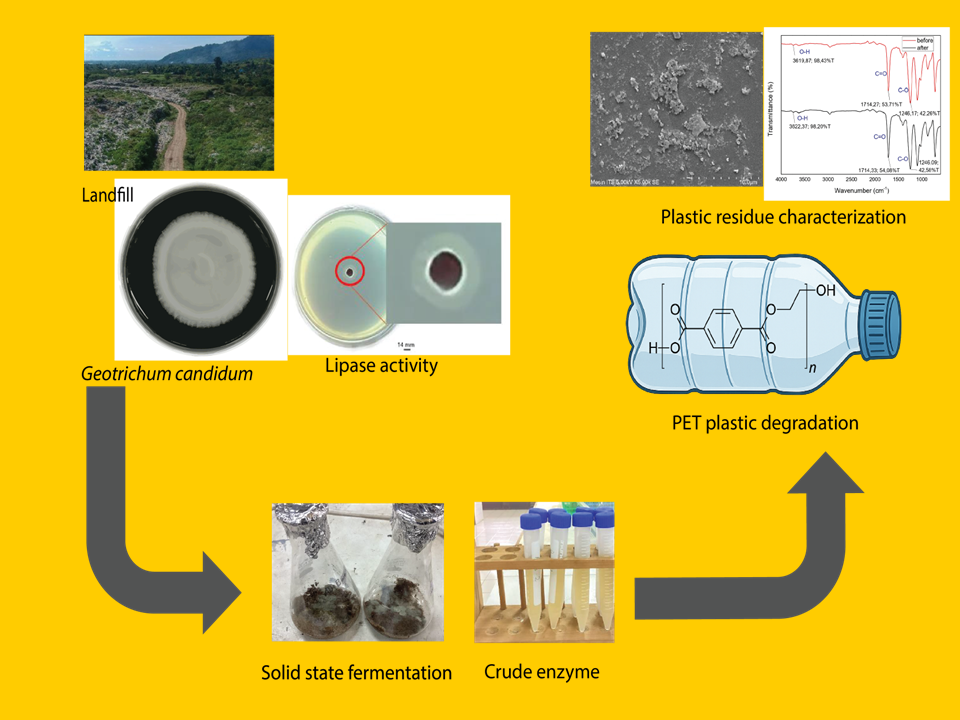
The issue of plastic waste, particularly polyethylene terephthalate (PET), has become a major global environmental concern due to its resistance to natural degradation. One promising approach to addressing PET waste is the use of lipase enzymes produced by microorganisms. This study aims to explore the potential of the fungus Geotrichum candidum J1 to produce crude lipase enzymes capable of degrading PET plastic. The research involved stages including isolation and rejuvenation of the fungus, enzyme production through solid-state fermentation, and lipase activity assay using the cup-plate method. Subsequently, PET degradation testing was carried out using the crude enzyme extract under controlled conditions for 30 days. The results indicated that the crude lipase from G. candidum J1 exhibited lipolytic activity, as evidenced by clear zones formed on selective media. The average total protein yield reached 2.992 ± 0.05 mg/mL, indicating stable fermentation. Degradation tests showed a weight loss of PET between 5.9% and 6.4%. Characterization by Fourier Transform Infra Red (FTIR) confirmed the cleavage of ester bonds in PET structure, evidenced by spectral changes in carbonyl groups. Observations using a Scanning Electron Microscope (SEM) revealed morphological changes, including cracks and pores, on the PET surface post-treatment. In conclusion, the crude lipase from G. candidum J1 demonstrates significant potential as a biodegradation agent for reducing PET plastic pollution in an environmentally friendly manner.
References
[1] Geyer, R., Jambeck, J.R. and Law, K.L. 2017. Production, use, and fate of all plastics ever made. Sci. Adv. 3(7). p.e1700782. doi: https://doi.org/10.1126/sciadv.1700782.
[2] Temporiti, M.E.E., Nicola, L., Nielsen, E. and Tosi, S. 2022. Fungal enzymes involved in plastics biodegradation. Microorganisms. 10(6). 1180. doi: https://doi.org/10.3390/microorganisms10061180.
[3] Pang, J., Zheng, M., Sun, R., Wang, A., Wang, X. and Zhang, T. (2016). Synthesis of ethylene glycol and terephthalic acid from biomass for producing PET. Green Chem. 18(2). 342-359. doi: https://doi.org/10.1039/c5gc01771h.
[4] Kim, J.Y. and Youn, D.H. 2023. Nanomaterials for advanced photocatalytic plastic conversion. Molecules. 28(18). 6502. doi: https://doi.org/10.3390/molecules28186502.
[5] Felisha, S.N.R., 2024. Identification of bacteria from the soil of the cold water final disposal site (TPA) in Padang City and characterization of their ability to degrade low density polyethylene (LDPE). Doctoral dissertation. Universitas Andalas.
[6] Siti, A.S.Z. 2023. Biodegradation of polyethylene (PE) and polystyrene (PS) plastics by fungi isolated from soil of the air kingdom final disposal site (land) in padang city. Doctoral dissertation. Universitas Andalas.
[7] Shi, K.E., Su, T. and Wang, Z. 2019. Comparison of poly (butylene succinate) biodegradation by Fusarium solani cutinase and Candida antarctica lipase. Polym. Degrad. Stab. 164. 55-60. doi: https://doi.org/10.1016/j.polymdegradstab.2019.04.005.
[8] Ekanayaka, A.H., Tibpromma, S., Dai, D., Xu, R., Suwannarach, N., Stephenson, S.L., Dao, C. and Karunarathna, S.C. 2022. A review of the fungi that degrade plastic. J. Fungi. 8(8). 772. doi: https://doi.org/10.3390/jof8080772.
[9] Kakde, R.B. and Chavan, A.M. 2011. Extracellular lipase enzyme production by seed-borne fungi under the influence of physical factors. Int. J. Biol. 3(1). 94. doi: https://doi.org/10.5539/ijb.v3n1p94.
[10] Safdar, A., Ismail, F. and Imran, M. 2024. Biodegradation of synthetic plastics by the extracellular lipase of Aspergillus niger. Environ. Adv. 17. 100563. doi: https://doi.org/10.1016/j.envadv.2024.100563.
[11] Niyonzima, F.N. and More, S.S. 2013. Screening and identification of a novel alkaline lipase producing bacterium. Int. J. Pharm. Bio. Sci. 4(2). 1037-1045.
[12] Singh, A.K. and Mukhopadhyay, M. 2012. Overview of fungal lipase: a review. Appl. Biochem. Biotechnol. 166(2). 486-520. doi: https://doi.org/10.1007/s12010-011-9444-3.
[13] Yoshida, S., Hiraga, K., Taniguchi, I. and Oda, K. 2021. Ideonella sakaiensis, PETase, and MHETase: From identification of microbial PET degradation to enzyme characterization. Methods Enzymol. 648. 187-205. doi: https://doi.org/10.1016/bs.mie.2020.12.007.
[14] Varshney, S., Gupta, V., Yadav, A.N., Rahi, R.K., Devki and Neelam, D.K. 2023. An overview on role of fungi in systematic plastic degradation. J. Appl. Biol. Biotechnol. 11(3). 61–69. doi: https://doi.org/10.7324/JABB.2023.108929.
[15] Harshvardhan, K. and Jha, B. 2013. Biodegradation of low-density polyethylene by marine bacteria from pelagic waters, Arabian Sea, India. Mar. Pollut. Bull. 77(1-2). 100-106. doi: https://doi.org/10.1016/j.marpolbul.2013.10.025.
[16] Safdar, A., Ismail, F., Iftikhar, H., Majid Khokhar, A., Javed, A., Imran, M. and Safdar, B., 2024. Determination of biodegradation potential of Aspergillus niger, Candida albicans, and Acremonium sclerotigenum on polyethylene, polyethylene terephthalate, and polystyrene microplastics. Int. J. Microbiol. 2024(1). 7682762. doi: https://doi.org/10.1155/2024/7682762.
Downloads
Published
How to Cite
Issue
Section
License
Copyright (c) 2025 Indonesian Journal of Chemical Studies

This work is licensed under a Creative Commons Attribution-ShareAlike 4.0 International License.