The Effect of Germination Time and Aloe vera Rind Ratio on Physicochemical and Nutritional Properties of Peanut Sprout Snack Bars: ROC-SAW Approach for Product Optimization
DOI:
https://doi.org/10.55749/ijcs.v4i2.148Keywords:
Aloe vera, Amino acids, Antioxidant activity, Decision-making, Peanut sprout snack barAbstract
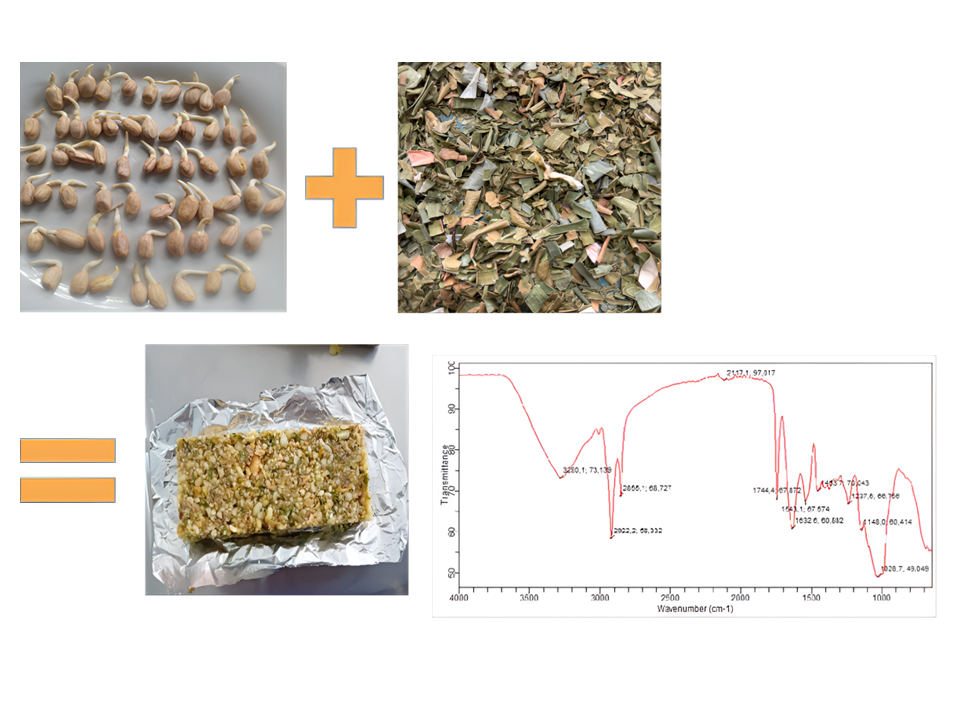
This study examined the effects of peanut germination time and the ratio of germinated peanut sprout flour to aloe vera rind flour on snack bar quality. Two experimental parameters were used in the study: flour proportions of 90:10, 80:20, and 70:30, and germination times of 12, 24, and 36 hours. The first evaluation concentrated on proximate composition, which included quantities of moisture, ash, fat, protein, fiber, and carbohydrates. Both factors and their interaction had a substantial (p < 0.05) impact on all proximal metrics. In order to determine the best formulation, these proximate data were then integrated into a multi-criteria decision-making framework using the Rank Order Centroid (ROC) and Simple Additive Weighting (SAW) techniques. The ROC–SAW results showed that the best combination of a 36-hour germination period and a 70:30 flour ratio yielded 23.79% protein, 8.81% fiber, 15.15% fat, and 31.37% carbohydrates. Additional analyses of the optimized formulation included antioxidant evaluation, amino acid profile, and FT-IR spectroscopy. FT-IR spectra revealed the presence of functional groups such as hydroxyl, carbonyl, amide, alcohol, and ether. Aspartic acid, glutamate, and arginine were the most frequently detected amino acids. The antioxidant activity IC50 value obtained from the DPPH experiment was 10,734.27 ppm. All things considered, combining germinated peanut sprout flour with aloe vera rind flour shows promise for producing a functional snack bar with enhanced nutritional content and bioactive potential.
References
[1] Constantin, O.E. & Istrati, D.I. 2019. Functional properties of snack bars, in Functional Foods. London, U.K.: IntechOpen. doi: https://doi.org/10.5772/intechopen.81020
[2] Coello, K.E., Frias, J., Martínez-Villaluenga, C., Cartea, M.E., Velasco, P., & Peñas, E. 2022. Manufacture of healthy snack bars supplemented with moringa sprout powder. LWT. 154. 112828. doi: https://doi.org/10.1016/j.lwt.2021.112828
[3] Indrawan, I., Seveline, S., & Ningrum, R.I.K. 2018. Pembuatan snack bar tinggi serat berbahan dasar tepung ampas kelapa dan tepung kedelai. Jurnal Ilmiah Respati. 9(2). 1–10. doi: https://doi.org/10.52643/jir.v9i2.290
[4] Biswas, S. 2021. Basic Food Chemistry. Ocean Publishing House. pp. 25–45.
[5] Falah, M.S., Priyono, S., & Fadly, D. 2022. Formulation of snack bar red rice flour (Oryza nivara) and edamame (Glycine max (L.) Merrill): Physicochemical characteristic and sensory. FoodTech: Jurnal Teknologi Pangan. 5(1). 25–32. doi: https://doi.org/10.26418/jft.v5i1.57341
[6] Asriasih, D.N., Purbowati, & Anugrah, R.M. 2020. Nutrition value of mixed flour snack bar (mocaf & red bean flour) and commercial snack bar. Jurnal Gizi dan Kesehatan. 12(27). 21–27.
[7] Taula’bi’, M.S.D., Yoakhim, Y.E.O., & Maria, F.S. 2021. Kajian komposisi kimia snack bars dari berbagai bahan baku lokal: Systematic review. Jurnal Transdisiplin Pertanian. 17(1). 15–20.
[8] Narsih & Agato. 2021. Volatile compound phenolics and microstructure of aloe vera rind powder cells with maltodextrin as their capsules and variations in drying temperature. Curr. Res. Nutr. Food Sci. 9(1). 320–328. doi: https://doi.org/10.12944/CRNFSJ.9.1.30
[9] Sariati, Pratama, B.S., Afnita, D.Y., Pertiwi, A.H., Maulana, R.S., Lestianti, K.A., Fahoorezy, F.D., & Gaol, M.L. 2025. Implementasi ROC dan SAW untuk pengambilan keputusan mutu hedonik seduhan teh herbal Rosella–Serai–Stevia dengan kontrol temperatur relay berbasis Arduino. TELEKONTRAN. 13(2). 259–270. doi: https://doi.org/10.34010/telekontran.v13i2.17738
[10] Pratama, B.S., Alfiqriyansyah, A., Dwicahya, A.S., Rukmana, F.H., Hartati, I.D., Brutu, H.L.C., Winda, & Sariati. 2024. Sensory preference determination of green tea extracts from uncontrolled and relay-controlled brewing processes using rank order centroid and simple additive weighting. Machine: Jurnal Teknik Mesin. 10(2). 90–97. doi: https://doi.org/10.33019/jm.v10i2.5727
[11] Horwitz, W. & Latimer, G.W.J. 2005. Official Methods of Analysis of AOAC International. 18th ed. Gaithersburg, MD, USA: AOAC International.
[12] Dewi, S.S., Fadhila, R., Kuswari, M., Palupi, K.C., & Utami, D.A. 2021. Pembuatan snackbar sebagai makanan tambahan olahraga sebagai sumber tinggi kalori. Jurnal Pangan dan Gizi. 11(2). 100–110. doi: https://doi.org/10.26714/jpg.11.2.2021.100-110
[13] Dewi, F.A.S., Wulandari, Y.W., & Widanti, Y.A. 2021. Komposisi gizi dan sifat sensoris snack bar dengan variasi rasio tepung gembili (Dioscorea esculenta L.) dan tepung pisang (Musa paradisiaca L.). JITIPARI. 6(1). 17–29.
[14] Nemzer, B. & Al-Taher, F. 2023. Analysis of fatty acid composition in sprouted grains. Foods. 12(9). 1853. doi: https://doi.org/10.3390/foods12091853
[15] Li, Y.-C., Qian, H., Sun, X.-L., Cui, Y., Wang, H.-Y., Du, C., & Xia, X.-H. 2014. The effects of germination on chemical composition of peanut seed. Food Sci. Technol. Res. 20(4). 883–889. doi: https://doi.org/10.3136/fstr.20.883
[16] Añibarro-Ortega, M., Pinela, J., Barros, L., Ćirić, A., Silva, S.P., Coelho, E., Mocan, A., Calhelha, R.C., Soković, M., Coimbra, M.A., & Ferreira, I.C.F.R. 2019. Compositional features and bioactive properties of Aloe vera leaf (fillet, mucilage, and rind) and flower. Antioxidants. 8(10). 444. doi: https://doi.org/10.3390/antiox8100444
[17] Ferdiawan, N., Nurwantoro, & Dwiloka, B. 2019. Pengaruh lama waktu germinasi terhadap sifat fisik dan sifat kimia tepung kacang tolo (Vigna unguiculata L.). J. Teknol. Pangan. 3(2). 349–354. doi: https://doi.org/10.14710/jtp.2019.23840
[18] Anggrahini, S. 2009. Pengaruh lama pengecambahan terhadap kandungan α-tokoferol dan senyawa proksimat kecambah kacang hijau (Phaseolus radiatus L.). Agritech. 27(4). 152–157.
[19] Megat, R.M.R., Azrina, A., & Norhaizan, M.E. 2016. Study on legumes and fiber content. Int. Food Res. J. 23(1). 257–261.
[20] Ikram, A., Saeed, F., Afzaal, M., Imran, A., Niaz, B., Tufail, T., Hussain, M., & Anjum, F.M. 2021. Nutritional and end-use perspectives of sprouted grains: A comprehensive review. Food Sci. Nutr. 9(9). 4617–4628. doi: https://doi.org/10.1002/fsn3.2408
[21] Wong, K.H., Abdul Aziz, S., & Mohamed, S. 2008. Sensory aroma from Maillard reaction of individual and combinations of amino acids with glucose in acidic conditions. Int. J. Food Sci. Technol. 43(8). 1512–1519. doi: https://doi.org/10.1111/j.1365-2621.2006.01445.x
[22] Chauhan, P. & Kumar, A. 2020. Development of a microbial coating for cellulosic surface using aloe vera and silane. Carbohydr. Polym. Technol. Appl. 1. 100015. doi: https://doi.org/10.1016/j.carpta.2020.100015
[23] Bajer, D., Janczak, K., & Bajer, K. 2020. Novel starch/chitosan/aloe vera composites as promising biopackaging materials. J. Polym. Environ. 28(4). 1021–1039. doi: https://doi.org/10.1007/s10924-020-01661-7
[24] Ossman, M.E., Mansour, M.S., Fattah, M.A., Taha, N., & Kiros, Y. 2014. Peanut shells and talc powder for removal of hexavalent chromium from aqueous solutions. Bulg. Chem. Commun. 46(3). 629–639.
[25] Haque, M.Z., Rahman, M.M., Shahjadee, U.F., Rahman, M.M., Rupa, A.Z., & Jalil, M.A. 2017. Amino acids, enzyme activity and effect of chemical agents, metallic salts on the stability of α-amylase and protease from Aloe barbadensis Miller. Bangladesh J. Bot. 46(4). 1375–1379.
[26] Sun, J., Zhang, C., Song, Y., Chu, B., Wang, M., Zhang, Z., & Wang, X. 2024. Characterization of key aroma compounds and main contributing amino acids in hot-pressed oil prepared from various peanut varieties. Molecules. 29(9). 1947. doi: https://doi.org/10.3390/molecules29091947
Downloads
Published
How to Cite
Issue
Section
License
Copyright (c) 2025 Indonesian Journal of Chemical Studies

This work is licensed under a Creative Commons Attribution-ShareAlike 4.0 International License.