Antibacterial and Antioxidant Activities of Endophytic Fungal Extracts from Pluchea indica (L.) Less.
DOI:
https://doi.org/10.55749/ijcs.v5i1.124Keywords:
Antibacterial, Antioxidant, Endophytic fungi, Pluchea indicaAbstract
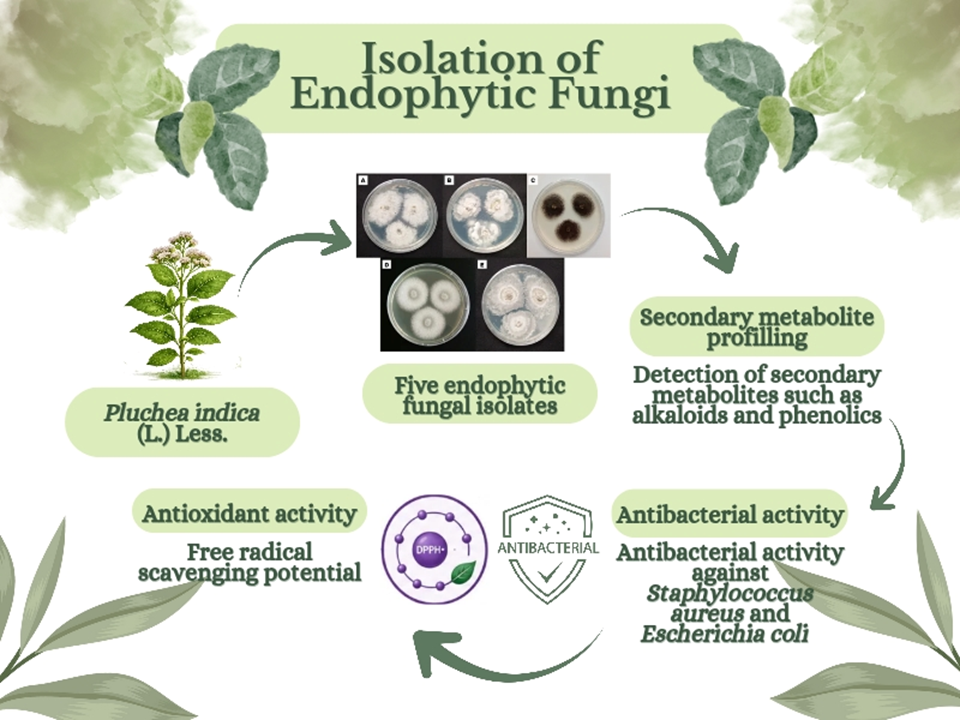
This study investigated endophytic fungi associated with Pluchea indica (L.) Less, focusing on their chemical profiles and biological potential. A total of five isolates were successfully obtained from leaves and stems. Morphological examination led us to identified the fungal isolates -as Aspergillus section Nigri 12TBt-3, Colletotrichum sp. 12TDn-1, Diaporthe sp. (Phomopsis sp.) 12TBt-1, Diaporthe sp. (Phomopsis sp.) 12TBt-2, and Diaporthe sp. (Phomopsis sp.) 12TDn-2. Thin-layer chromatography (TLC) analysis revealed distinct secondary metabolite profiles among the isolates, with the detection of alkaloids and phenolic compounds, particularly in extracts Aspergillus section Nigri 12TBt-3 and Diaporthe sp. (Phomopsis sp.) 12TDn2. Antibacterial activity was evaluated qualitatively by TLC bioautography and quantitatively by microdilution assays. Extract Aspergillus section Nigri 12TBt-3 exhibited moderate inhibitory activity against Staphylococcus aureus (MIC 128 µg/mL) and Escherichia coli (MIC 256 µg/mL). Antioxidant activity, assessed using the DPPH assay, demonstrated that the extract Aspergillus section Nigri 12TBt-3 possessed strong activity with an IC50 value of 27.31 µg/mL and an Antioxidant Activity Index (AAI) of 1.14. In addition, total phenolic content analysis revealed that the extract Aspergillus section Nigri 12TBt-3 contained 257.179 mg GAE/g extract, while Diaporthe sp. (Phomopsis sp.) 12TDn2 contained 67.249 mg GAE/g extract. Collectively, these findings indicate that endophytic fungi from Pluchea indica (L.) Less, particularly isolated Aspergillus section Nigri 12TBt-3, harbor significant potential as sources of bioactive metabolites with antibacterial and antioxidant properties, supporting their prospective application in biotechnology and pharmaceutical development.
References
[1] Wahyuni, D.K., Junairiah, J., Rosyanti, C., Kharisma, V.D., Syukriya, A.J., Rahmawati, C.T., Purkan, P., Subramaniam, S., Prasongsuk, S. and Purnobasuki, H. 2024. Computational and in vitro analyses of the antibacterial effect of the ethanolic extract of Pluchea indica L. leaves. Biomed. Rep. 21(4). 137. Doi: https://doi.org/10.3892/br.2024.1825
[2] Hikmawanti, N.P.E., Saputri, F.C., Yanuar, A., Jantan, I., Ningrum, R.A. and Mun'im, A., 2024. Insights into the anti-infective effects of Pluchea indica (L.) Less and its bioactive metabolites against various bacteria, fungi, viruses, and parasites. J. Ethnopharmacol. 320. 117387. Doi: https://doi.org/10.1016/j.jep.2023.117387
[3] Putra, P.W.K., Jawi, I.M., Subawa, A.A.N., Astawa, N.M., Indrayani, A.W., Widhiantara, I.G., Wiradana, P.A. and Herdiansyah, M.A. 2025. Phytochemicals of Beluntas (Pluchea indica (L) Less.) and their health benefits. Appl. Pharm. Sci. 15(7). 037-047. Doi: https://doi.org/10.7324/JAPS.2025.237559
[4] Raunsai, M., Wulansari, D., Fathoni, A. and Agusta, A. 2018. Antibacterial and antioxidant activities of endophytic fungi extracts of medicinal plants from Central Sulawesi. Appl. Pharm. Sci. 8(8). 069-074. Doi: https://doi.org/10.7324/JAPS.2018.8811
[5] Palupi, K.D., Oktavia, L., Wulansari, D., Fathoni, A., Praptiwi, P., Rahmi, D. and Agusta, A. 2025. Plant endophytic fungi: powerful catalytic cells for biotransformation of chemical structures of biologically active compounds. Chem. Biodivers. 22(5), 202402281. Doi: https://doi.org/10.1002/cbdv.202402281
[6] Rahmi, D., Praptiwi, Simajuntak, P., Ilyas, M. and Agusta, A. 2023. The antioxidant activity of endophytic fungal extract of nutmeg plant (Myristica fragrans Houtt.) from Cimande West Java, Indonesia. IOP Conf. Ser. Earth Environ. Sci. 1271(1). 012063. Doi: https://doi.org/10.1088/1755-1315/1271/1/012063
[7] Gupta, A., Meshram, V., Gupta, M., Goyal, S., Qureshi, K.A., Jaremko, M. and Shukla, K.K. 2023. Fungal endophytes: Microfactories of novel bioactive compounds with therapeutic interventions; A comprehensive review on the biotechnological developments in the field of fungal endophytic biology over the last decade. Biomolecules. 13(7), 1038. Doi: https://doi.org/10.3390/biom13071038
[8] Pal, P.P., Shaik, A.B. and Begum, A.S. 2020. Prospective leads from endophytic fungi for anti-inflammatory drug discovery. Planta Med. 86(13/14). 941-959. Doi: https://doi.org/10.1055/a-1140-8388
[9] Yuan, Y., Wang, G., She, Z., Chen, Y. and Kang, W. 2023. Metabolites isolated from the mangrove endophytic fungus Didymella sp. CYSK-4 and their cytotoxic activities. Fitoterapia. 171. 1–6. Doi: https://doi.org/10.1016/j.fitote.2023.105692
[10] Chen, Y., Liu, Z., Liu, H., Pan, Y., Li, J., Liu, L. and She, Z. 2018. Dichloroisocoumarins with potential anti-inflammatory activity from the mangrove endophytic fungus Ascomycota sp. CYSK-4. Mar. drugs. 16(2). 54. Doi: https://doi.org/10.3390/md16020054
[11] Setiawan, M.A. and Musdalipah, M. 2018. Uji daya hambat antibakteri fungi endofit daun Beluntas (Pluchea indica (L.) Less.) terhadap bakteri Streptococcus mutans. J. Mandala Pharmacon Ind. 4(1). 53-60. Doi: https://doi.org/10.35311/jmpi.v4i1.24
[12] Raunsai, M.M., Nurhayati, O.S., Kamal, A.S., Palupi, K.D., Ilyas, M., Ridwan, R. and Agusta, A. 2024. Isolation and in vitro bioassays of endophytic fungi associated with lidah buaya (Aloe vera (L.) Burm. f.). Berita Biologi, 23(2). 197-206. Doi: https://doi.org/10.55981/beritabiologi.2024.3879
[13] Ilyas, M., Praptiwi, Wulansari, D., Fathoni, A. and Agusta, A. 2019. An assemblages of fungal endophytes isolated from medicinal plants collected from Toba and Samosir, North Sumatra. IOP Conf. Ser. Earth Environ. Sci. 308(1). 12070. Doi: https://doi.org/10.1088/1755-1315/308/1/012070
[14] Fathoni, A., Ilyas, M., Wulansari, D. and Agusta, A. 2022. Antibacterial and antioxidant activities of fungal endophytes isolated from medicinal plants in Simeulue Island, Aceh. HAYATI J. Biosci. 29(6). 720-732. Doi: https://doi.org/10.4308/hjb.29.6.720-732
[15] Runtuwene, M.R. 2012. Penentuan total fenolik dan uji aktivitas antioksidan pada biji dan kulit buah pinang yaki (Areca vestiaria Giseke). J. Ilm. Sains. 12(2). 84. Doi: https://doi.org/10.35799/jis.12.2.2012.557
[16] Murali, T.S., Suryanarayanan, T.S. and Geeta, R. 2006. Endophytic Phomopsis species: host range and implications for diversity estimates. Can. J. Microbiol. 52(7). 673–680. Doi: https://doi.org/10.1139/w06-020
[17] Ilyas, M., Nurcahyanto, D.A., Yuliani, Y., Mangunwardoyo, W. and Hidayat, A.I. 2021, March. Preliminary study of black aspergilli inhabiting Piper rhizosphere from Eka Karya Botanical Garden, Bedugul Bali. IOP Conf. Ser. Earth Environ. Sci. 712(1). 12019. Doi: https://doi.org/10.1088/1755-1315/712/1/012019
[18] O'Connell, R.J., Thon, M.R., Hacquard, S., Amyotte, S.G., Kleemann, J., Torres, M.F., Damm, U., Buiate, E.A., Epstein, L., Alkan, N. and Altmüller, J. 2012. Lifestyle transitions in plant pathogenic Colletotrichum fungi deciphered by genome and transcriptome analyses. Nat. Genet. 44(9). 1060–1065. Doi: https://doi.org/10.1038/ng.2372
[19] Fang, K., Miao, Y.F., Chen, L., Zhou, J., Yang, Z.P., Dong, X.F. and Zhang, H.B. 2019. Tissue-specific and geographical variation in endophytic fungi of Ageratina adenophora and fungal associations with the environment. Front. Microbiol. 10. 1–16. Doi: https://doi.org/10.3389/fmicb.2019.02919
[20] Ramírez-Villalobos, J.M., Gomez-Flores, R., Velázquez-Flores, P.V., Morán-Santibáñez, K.S., Tamez-Guerra, P., Pérez-González, O., de la Garza-Ramos, M.A., Rodríguez-Padilla, C. and Romo-Sáenz, C.I. 2023. Effect of culture conditions of Lophocereus marginatus endophytic fungi on yield and anticancer and antioxidant activities. Int. J. Environ. Res. Public Health. 20(5). Doi: https://doi.org/10.3390/ijerph20053948
[21] Fathoni, A., Hudiyono, S., Budianto, E., Cahyana, A.H. and Agusta, A. 2021. Metabolite detection and antibacterial activity of fungal endophytic extracts isolated from Brotowali (Tinospora crispa) plants using TLC-bioautography assay. IOP Conf. Ser. Mater. Sci. Eng. 1011(1). Doi: https://doi.org/10.1088/1757-899X/1011/1/012041
[22] Qodrie, E.N.P., Windradi, F.I., Sahroni, D., and Praotiwi, P. 2022. Potential antibacterial, antioxidant, total phenolic and flavonoid content of Trigonachras celebensis extract from Banggai Islands, Central Sulawesi, Indonesia. Pros. Sem. Nas. Mas. Biodiv. Ind. 8(1). Doi: https://doi.org/10.13057/psnmbi/m080107
[23] Scherer, R. and Godoy, H.T. 2009. Antioxidant activity index (AAI) by the 2, 2-diphenyl-1-picrylhydrazyl method. Food chem. 112(3). 654-658. Doi: https://doi.org/10.1016/j.foodchem.2008.06.026
Downloads
Published
How to Cite
Issue
Section
License
Copyright (c) 2026 Indonesian Journal of Chemical Studies

This work is licensed under a Creative Commons Attribution-ShareAlike 4.0 International License.