Adsorption of Malachite Green using Coconut Shell–Graphite Oxide (CS-GiO): Kinetic and Isotherm Studies
DOI:
https://doi.org/10.55749/ss.v2i1.160Keywords:
Adsorption isotherm, Adsorption kinetics, Dye wastewater, Graphite oxide, Malachite greenAbstract
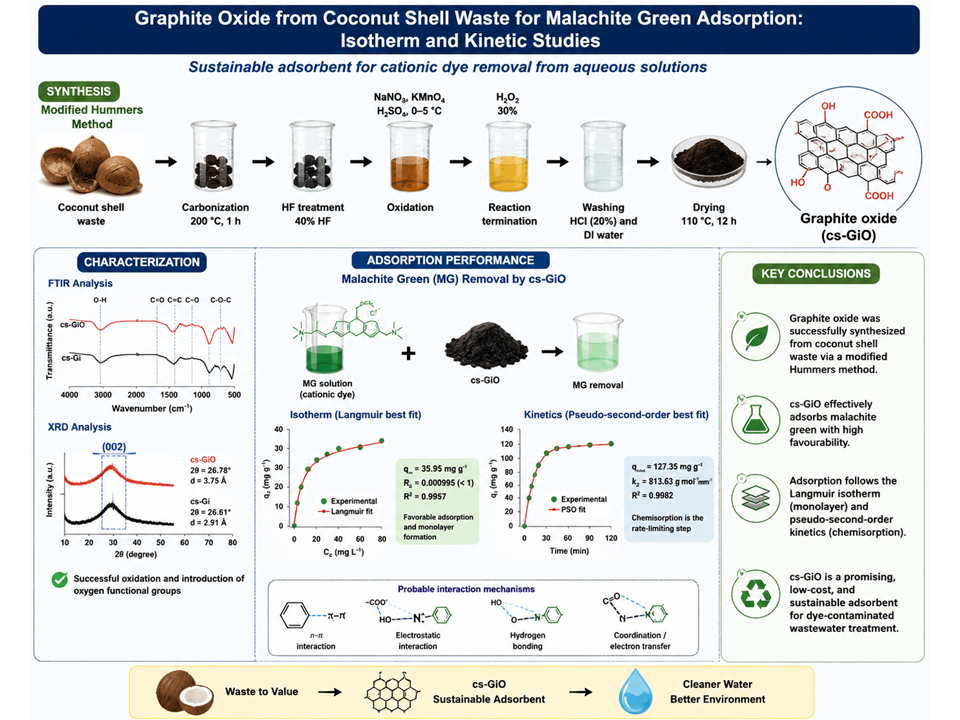
Malachite green (MG) is a toxic cationic dye commonly found in textile wastewater and poses serious environmental and health risks. In this study, coconut shell–derived graphene oxide (CS-GiO) was synthesized and evaluated as an adsorbent for the removal of MG from aqueous solutions. The material was prepared through carbonization of coconut shells followed by a modified Hummers method to oxidize coconut shell graphite (CS-Gi) into graphene oxide. Prior to oxidation, the carbonized material was purified using HF treatment. Structural characterization using FTIR confirmed the presence of oxygen-containing functional groups, indicating successful oxidation of CS-Gi into CS-GiO. Meanwhile, XRD analysis revealed the characteristic (002) diffraction plane and showed that CS-GiO exhibited lower crystallinity compared to CS-Gi due to the incorporation of oxygen functional groups that disrupted the original crystalline structure. Adsorption behavior was evaluated through isotherm and kinetic studies. The adsorption equilibrium was better described by the Langmuir isotherm model (R² = 0.9957) than the Freundlich model (R² = 0.9617), indicating monolayer adsorption on relatively homogeneous active sites. The maximum adsorption capacity (qm) was 35.95 mg g⁻¹, with a Langmuir constant (KL) of 37873.42 L mol⁻¹ and a separation factor (RL = 0.000995), confirming that the adsorption process is highly favorable. Kinetic analysis revealed that the adsorption follows the pseudo-second-order (PSO) model (R² = 0.99818), with a rate constant (k₂) of 813.63 g mol⁻¹ min⁻¹ and an equilibrium adsorption capacity of 0.000349 mol g⁻¹, suggesting a relatively rapid adsorption process. The adsorption mechanism is likely dominated by chemisorption, involving interactions between oxygen-containing functional groups on the CS-GiO surface and cationic MG molecules through electrostatic attraction, coordination interactions, and possible electron transfer. These findings demonstrate that CS-GiO derived from coconut shells is a promising adsorbent for the efficient removal of malachite green from aqueous systems.
References
[1] Slama, H.B., Chenari Bouket, A., Pourhassan, Z., Alenezi, F.N., Silini, A., Cherif-Silini, H., Oszako, T., Luptakova, L., Golińska, P. and Belbahri, L. 2021. Diversity of synthetic dyes from textile industries, discharge impacts and treatment methods. Appl. Sci. 11(14). 6255. Doi: https://doi.org/10.3390/app11146255.
[2] Berradi, M., Hsissou, R., Khudhair, M., Assouag, M., Cherkaoui, O., El Bachiri, A. and El Harfi, A. 2019. Textile finishing dyes and their impact on aquatic environs. Heliyon. 5(11). e02711. doi: https://doi.org/10.1016/j.heliyon.2019.e02711.
[3] Bian, Y., Zhang, Y., Chen, Z.Y., Xu, L., Zhang, C.Y., Shi, D., Feng, X.S. and Wang, X.Q. 2025. Malachite green in environmental samples: Updates on sources, fates, distribution and removal techniques. Ecotoxicol. Environ. Saf. 303. 118978. doi: https://doi.org/10.1016/j.ecoenv.2025.118978.
[4] Shilyaeva, E.A. and Novakovskaya, Y.V. 2019. Functional groups of graphite oxide: experimental data and ab initio modeling. Russ. J. Phys. Chem. A. 93(10). 1908-1917. doi: https://doi.org/10.1134/S0036024419100273.
[5] Sujiono, E.H., Zabrian, D., Dahlan, M.Y., Amin, B.D. and Agus, J. 2020. Graphene oxide based coconut shell waste: synthesis by modified Hummers method and characterization. Heliyon. 6(8). e04568. doi: https://doi.org/10.1016/j.heliyon.2020.e04568.
[6] Asih, R., Yutomo, E.B., Ristiani, D., Baqiya, M.A., Kawamata, T., Kato, M., Watanabe, I., Koike, Y. and Darminto, D. 2019. Comparative study on magnetism of reduced graphene oxide (rGO) prepared from coconut shells and the commercial product. In Mater. Sci. Forum. 966. 290-295. doi: https://doi.org/10.4028/www.scientific.net/MSF.966.290.
[7] Mohammed, M.N., Aljibori, H.S.S., Jweeg, M.J., Al Oqaili, F., Abdullah, T.A., Abdullah, O.I., Meharban, F., Rashed, R.T., Aldulaimi, M. and Al-Azawi, K. 2024. A comprehensive review on graphene oxide based nanocomposites for wastewater treatment. Polish J. Chem. Technol. 26(1). 64-79. doi: https://doi.org/10.2478/pjct-2024-0007.
[8] Liu, X., Ma, R., Wang, X., Ma, Y., Yang, Y., Zhuang, L., Zhang, S., Jehan, R., Chen, J. and Wang, X. 2019. Graphene oxide-based materials for efficient removal of heavy metal ions from aqueous solution: A review. Environ. Pollut. 252. 62-73. doi: https://doi.org/10.1016/j.envpol.2019.05.050.
[9] Bolilanga, P.I.W., Basuki, R., Apriliyanto, Y.B., Prasojo, A.E., Lazuardy, A., Anitasari, R., Putri, R., Sasongko, N.A. and Santiko, A.B. 2024. Immobilization of Cerium(IV) Oxide onto reduced graphene oxide in epoxy resin matrix as radar absorbing composite for X-Band region. Indones. J. Chem., 24(6). 1688-1700. doi: https://doi.org/10.22146/ijc.94404.
[10] Sharma, N., Sharma, V., Jain, Y., Kumari, M., Gupta, R., Sharma, S.K. and Sachdev, K. 2017. Synthesis and characterization of graphene oxide (GO) and reduced graphene oxide (rGO) for gas sensing application. Macromol. Symp. 376(1). 1700006. doi: https://doi.org/10.1002/masy.201700006.
[11] Kumar, H.V., Oyer, A.J., Huang, K.Y.S. and Adamson, D.H. 2022. Evolution of heterogeneity and chemical functionality during the oxidation of graphite. Colloids and Interfaces. 6(3). 44. doi: https://doi.org/10.3390/colloids6030044.
[12] Fahri, M., Bolilanga, P.I.W., Gunaryo, G., Stiawan, E. and Kurniadi, T., 2024. Exploring the potential of carbon-based radar absorbing material innovations. Indones. J. Chem. Stud. 3(2). 72-81. doi: https://doi.org/10.55749/ijcs.v3i2.56.
[13] Ngatijo, N., Gusmaini, N., Bemis, R. and Basuki, R. 2021. Adsorpsi methylene blue pada nanopartikel magnetit tersalut asam humat: kajian isoterm dan kinetika. CHEESA Chem. Eng. Res. Artic. 4(1). 51-64. doi: https://doi.org/10.25273/cheesa.v4i1.8433.51-64.
[14] Sah, M.K., Edbey, K., EL-Hashani, A., Almshety, S., Mauro, L., Alomar, T.S., AlMasoud, N. and Bhattarai, A. 2022. Exploring the biosorption of methylene blue dye onto agricultural products: A critical review. Separations. 9(9). 256. doi: https://doi.org/10.3390/separations9090256.
[15] Dehbi, A., Dehmani, Y., Omari, H., Lammini, A., Elazhari, K. and Abdallaoui, A. 2020. Hematite iron oxide nanoparticles (α-Fe2O3): synthesis and modelling adsorption of malachite green. J. Environ. Chem. Eng. 8(1). 103394. doi: https://doi.org/10.1016/j.jece.2019.103394.
[16] Basuki, R., Apriliyanto, Y.B., Stiawan, E., Pradipta, A.R., Rusdiarso, B. and Putra, B.R. 2025. Magnetic hybrid chitin-horse manure humic acid for optimized Cd (II) and Pb (II) adsorption from aquatic environment. Case Stud. Chem. Environ. Eng. 11. 101138. doi: https://doi.org/10.1016/j.cscee.2025.101138.
[17] Dive, A.M., Song, M.K. and Banerjee, S. 2017. Physisorption mechanism of solvated polysulfide chains on graphene oxides with varied functional groups. J. Phys. Chem. C. 121(9). 5089-5098. doi: https://doi.org/10.1021/acs.jpcc.6b12468.
[18] Kuntjahjono, M.F.P., Lestari, A.P., Nurhalimah, S., Sarweswara, W., Purba, F.O., Kaunang, A.M., Sasongko, N.A. and Basuki, R., 2025. Synthesis of Fe₃O₄ using the Co-precipitation method with temperature and time treatment as methylene blue adsorbent. Sorpt. Stud. 1(2). 48-53. doi: https://doi.org/10.55749/ss.v1i2.94.
[19] Aisyah, A.N., Sandri, A., Hutama, R.R., Kuntjahjono, M.F.P., Napoleon, S., Basuki, R. 2025. Synthesis of magnetite/chitin/fulvic acid derived from goat manure compost and adsorption study of Zn (II) for water security enhancement. Sorpt. Stud. 1(1). 34-41. doi: https://doi.org/10.55749/ss.v1i1.82.
[20] Ananda, D.D., Napoleon, S., Tarigan, T.O.J., Yulita, T.R., Alivia, L.S., Kusuma, B., Fajri, M.R., Putri, K.S., Artdero, N.V., Hartono, R., Basuki, R. 2025. Effect of different temperatures in magnetite synthesis on methylene blue adsorption. Sorpt. Stud. 1(2). 42-47. doi: https://doi.org/10.55749/ss.v1i2.84.
[21] Kavci, E., 2021. Malachite green adsorption onto modified pine cone: Isotherms, kinetics and thermodynamics mechanism. Chem. Eng. Commun. 208(3). 318-327. doi: https://doi.org/10.1080/00986445.2020.1715961.
[22] Hutama, R.R., Aisyah, A.N., Sandri, A., Kuntjahjono, M.F.P., Napoleon, S., Apriliyanto, Y.B., Sasongko, N.A., Basuki, R. 2025. Adsorption Ni(II) on magnetic fulvic acid-chitosan: kinetics and isotherm study. Sorpt. Stud. 1(1). 13-20. doi: https://doi.org/10.55749/ss.v1i1.79.
Downloads
Published
How to Cite
Issue
Section
License
Copyright (c) 2026 Sorption Studies

This work is licensed under a Creative Commons Attribution-ShareAlike 4.0 International License.