Effectiveness Comparison of Activated Carbon/MnO₂ Composite and Mg(OH)₂-Impregnated Activated Carbon as Adsorbents for Uranium Removal from Nuclear Waste : A Review
DOI:
https://doi.org/10.55749/ss.v2i1.157Keywords:
Activated carbon/MnO₂ composite, Mg(OH)₂-impregnated carbon, Nuclear waste, Uranium adsorptionAbstract
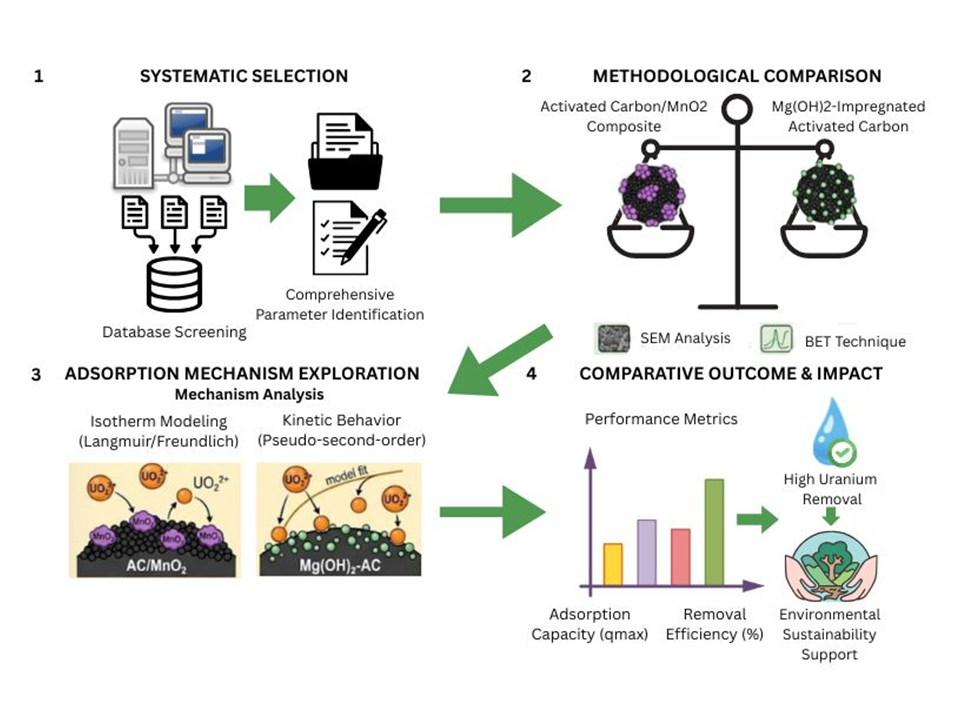
Uranium contamination in nuclear wastewater poses significant environmental and health risks due to its radiotoxicity and persistence, necessitating the development of efficient adsorbent materials for its removal. This article discusses the effectiveness of two types of adsorbents: Activated Carbon/MnO2 Composite and Mg(OH)2-Impregnated Activated Carbon, in removing uranium from nuclear waste. Activated carbon/MnO2 composites exhibit high surface area and oxidative properties, enhancing uranium adsorption. In this study, Adsorption isotherm and kinetic analyses revealed that the composite achieved a maximum adsorption capacity of 65.5%, following the Langmuir model and pseudo-second-order kinetics. Meanwhile, Mg(OH)2-Impregnated Activated Carbon enhances the electrostatic interaction between adsorbents and uranium ions, thanks to its alkaline properties that favor the formation of chemical bonds. The maximum adsorption capacity of the predicted Mg(OH)2 reached 85 mg/g, with behavior that was also in accordance with the Langmuir isothermal model. Although both adsorbents show significant potential, the comparison shows that the choice between the two depends on the specific application conditions. The results of this research are expected to contribute to the development of more effective and sustainable nuclear waste management methods, as well as encourage innovation in water purification technology to overcome uranium contamination.
References
[1] Majérus, O., Lehuédé, P., Biron, I., Alloteau, F., Narayanasamy, S. and Caurant, D., 2020. Glass alteration in atmospheric conditions: crossing perspectives from cultural heritage, glass industry, and nuclear waste management. Npj Mater. Degrad. 4(1). 27. Doi: https://doi/10.1038/s41529-020-00130-9
[2] Ramadan, R.S., Dawood, Y.H., Yehia, M.M. and Gad, A. 2022. Environmental and health impact of current uranium mining activities in southwestern Sinai, Egypt. Environ. Earth Sci. 81(7). 213. Doi: https://doi.org/10.1007/s12665-022-10341-9
[3] Febrianti, S.K.D., A'la, D.G., Rahayu, C. and Yusal, Y. 2023. Dampak limbah nuklir negara Jepang dan Prancis terhadap lingkungan dan kesehatan. J. Pengelolaan Sumberd. Alam Lingkung. Wil. Pesisir. (2).
[4] Putri, G.R., Suwandito, G.M. and Caesari, P.Z. 2024. Pengaruh pembuangan limbah nuklir Jepang ke Samudra Pasifik dalam sudut pandang aksiologi. J. Ilm. Wahana Pendidik. 10(14): 583–589. Doi: https://doi.org/10.5281/zenodo.13731898
[5] Brown, A., Marlow, J. and Sorfleet, J. 2024. Crafting effective oversight for the long-term storage of spent nuclear fuel on sites at risk of climate and coastal hazards. Front. Clim. 6. 1356724. Doi: https://doi.org/10.3389/fclim.2024.1356724
[6] Agustia, J., Nabila, E.P., Mahardika, I.K. and Handono, S. 2023. Pengelolaan limbah nuklir dan pengaruhnya terhadap lingkungan. J. Lingkar Pembelajaran Inov. 4(4): 65–69.
[7] Saputra, D.L.I., Wati. and Nurhayati. 2023. Adsorpsi uranium menggunakan Na dan Zr-montmorillonite. Urania. 29(2): 105–114. Doi: https://doi.org/10.17146/urania.2023.29.2.6979
[8] Zhang, L., Chu, J., Xia, B., Xiong, Z., Zhang, S. and Tang, W. 2022. Health effects of particulate uranium exposure. Toxics. 10(10): 575. Doi: https://doi.org/10.3390/toxics10100575
[9] Purwanto, Y., Saputra, D.L.I., Mirawaty, M., Sugiharto, U., Wati, W., Rachmadetin, J. and Artiani, P.A. 2023. Adsorpsi uranium terlarut oleh komposit ammonium dihydrogen phosphate/zeolit. Urania. 29(2): 95–104. Doi: https://doi.org/10.17146/urania.2023.29.2.6974
[10] Lehtonen, M., Kojo, M., Kari, M., Jartti, T. and Litmanen, T. 2022. Trust, mistrust and distrust as blind spots of Social Licence to Operate: Illustration via three forerunner countries in nuclear waste management. J. Risk Res. 25(5): 577–593. Doi: https://doi.org/10.1080/13669877.2021.1957987
[11] Hussain, M., Zhao, L., Zhang, X., Yang, C., Cui, Y., Yu, Z. and Zheng, J. 2025. Functionalized carbon-based materials for uranium extraction: A review. Separations. 12(10): 283. Doi: https://doi.org/10.3390/separations12100283
[12] Anjarsari, N., Zaharah, T.A., Sayekti, E. and Yamin, B.M. 2024. Activated carbon/MnO₂ composite as uranium adsorbent in solution. CHEESA. 7(1): 24–35. Doi: https://doi.org/10.25273/cheesa.v7i1.13863
[13] Saputra, A., Swantomo, D., Ariyanto, T. and Sulistyo, H. 2019. Uranium removal from wastewater using Mg(OH)₂-impregnated activated carbon. Water Air Soil Pollut. 230(9). 213. Doi: https://doi.org/10.1007/s11270-019-4269-8
[14] Rahayu, L.H. and Purnavita, S. 2014. Pengaruh suhu dan waktu adsorpsi terhadap sifat kimia-fisika minyak goreng bekas hasil pemurnian menggunakan adsorben ampas pati aren dan bentonit. Momentum. 10(2): 35–41.
[15] Maulinda, L., Nasrul, Z.A., and Sari, D.N. 2015. Pemanfaatan kulit singkong sebagai bahan baku karbon aktif. J. Teknol. Kim. Unimal. 4(2): 11–19. Doi: https://doi.org/10.29103/jtku.v4i2.69
[16] Kusdarini, E., Budianto, A. and Ghafarunnisa, D. 2017. Produksi karbon aktif dari batubara bituminus dengan aktivasi tunggal H₃PO₄, kombinasi H₃PO₄–NH₄HCO₃, dan termal. Reaktor. 17(2): 74–80. Doi: https://doi.org/10.14710/reaktor.17.2.74-80
[17] Wang, J.W., Chen, Y. and Chen, B.Z.. 2015. A synthesis method of MnO₂/activated carbon composite for electrochemical supercapacitors. J. Electrochem. Soc. 162(8): A1654–A1661. Doi: https://doi.org/10.1149/2.0031509jes
[18] Walayudara, I.R., Laksmana, R.I., Marisi, D.P. and Amalia, S.N. 2019. Efisiensi penurunan kandungan uranium dalam limbah cair pengolahan monasit menggunakan resin penukar kation Tulsion T-40 Na. Eksplorium. 40(2): 135–142. Doi: https://doi.org/10.17146/eksplorium.2019.40.2.5627
[19] Rao, T.S., Panigrahi, S. and Velraj, P. 2022. Transport and disposal of radioactive wastes in nuclear industry. In: Microbial Biodegradation and Bioremediation: Techniques and Case Studies for Environmental Pollution. Elsevier. 419–440. Doi: https://doi.org/10.1016/B978-0-323-85455-9.00027-8
[20] Lee, J., Choi, H. and Cho, D. 2022. A study on thermal load management in a deep geological repository for efficient disposal of high level radioactive waste. J. Nucl. Fuel Cycle Waste Technol. 20(4): 469–488. Doi: https://doi.org/10.7733/jnfcwt.2022.032
[21] Buck, H.J. 2020. Should carbon removal be treated as waste management? Lessons from the cultural history of waste. Interface Focus. 10(5). Doi: https://doi.org/10.1098/rsfs.2020.0010
[22] Dehner, G., McBeth, M.K., Moss, R. and van Woerden, I. 2023. A zero-carbon nuclear energy future? Lessons learned from perceptions of climate change and nuclear waste. Energies. 16(4). Doi: https://doi.org/10.3390/en16042025
[23] Suherman, Hasanah, M., Ariandi R., and Ilmi. 2021. Pengaruh suhu aktivasi terhadap karakteristik dan mikrostruktur karbon aktif pelepah kelapa sawit (Elaeis guineensis). J. Ind. Has. Perkeb. 16(1). 1-9.
[24] Takwanto, A., Mustain, A. and Sudarminto, H.P. 2018. Pengaruh aktivasi terhadap karakteristik karbon aktif. J. Tek. Kim. 2(1): 11–16.
[25] do Nascimento Pereira, M.R., Salviano, A.B., de Medeiros, T.P.V., Santos, M.R.D., Cibaka, T.E., de Andrade, M.H.C., de Oliveira Porto, A. and Lago, R.M. 2018. Ca(OH)₂ nanoplates supported on activated carbon for the neutralization/removal of free fatty acids during biodiesel production. Fuel. 221. 469–475. Doi: https://doi.org/10.1016/j.fuel.2018.01.123
[26] Yusuf, M., Song, K., Geng, S. and Fazhi, X. 2020. Adsorptive removal of anionic dyes by graphene impregnated with MnO₂ from aqueous solution. Colloids Surf. A Physicochem. Eng. Asp. 595. 124667. Doi: https://doi.org/10.1016/j.colsurfa.2020.124667
[27] Alaqarbeh, M. 2021. Adsorption phenomena: Definition, mechanisms, and adsorption types: Short review. RHAZES Green Appl. Chem. 13. 43–51. Doi: https://doi.org/10.48419/IMIST.PRSM/rhazes-v13.28283
[28] Efimov, M., Vasilev, A., Muratov, D., Panin, A., Malozovskaya, M. and Karpacheva, G. 2024. Application of infrared pyrolysis and chemical post-activation in the conversion of polyethylene terephthalate waste into porous carbons for water purification. Polymers (Basel). 16(7). Doi: https://doi.org/10.3390/polym16070891
[29] Pontoh, C.E., Mauliddina, R. and Sahraeni, S. 2024. Penurunan kadar Fe dengan adsorben arang aktif dari gambut fibrik teraktivasi NaCl. J. Inov. Glob. 2(7). Doi: https://doi.org/10.58344/jig.v2i6
[30] Wijayanti, I.E. and Kurniawati, E.A. 2019. Studi kinetika adsorpsi isoterm persamaan Langmuir dan Freundlich pada abu gosok sebagai adsorben. EduChemia. 4(2): 175–186. Doi: https://doi.org/10.30870/educhemia.v4i2.6119
[31] Hanum, F., Gultom, R.J. and Simanjuntak, M. 2017. Adsorpsi zat warna metilen biru dengan karbon aktif dan kulit durian menggunakan KOH dan NaOH sebagai aktivator. J. Tek. Kim. USU. 6(1). Doi: https://doi.org/10.32734/jtk.v6i1.1565
[32] Haryanto, B., Sinaga, W.K. and Saragih, F.T. 2019. Kajian model interaksi pada adsorpsi logam berat kadmium (Cd²⁺) dengan menggunakan adsorben dari pasir hitam. J. Tek. Kim. USU. 8(2): 79–84. Doi: https://doi.org/10.32734/jtk.v8i2.2032
[33] Saputra, D.L.I., Wati. and Nurhayati. 2016. Pengolahan limbah uranium cair dengan resin anion Amberlite IRA-400 Cl dan imobilisasi resin jenuh menggunakan polimer. In: Pros. Semin. Nas. Teknol. Pengelolaan Limbah XIV. Jakarta. 118–123
Downloads
Published
How to Cite
Issue
Section
License
Copyright (c) 2026 Sorption Studies

This work is licensed under a Creative Commons Attribution-ShareAlike 4.0 International License.