Stealth Revolution: Advancing Equipment Performance with Nano Metal-Oxide Radar Absorbing Materials
DOI:
https://doi.org/10.55749/ss.v2i1.156Keywords:
Dielectric loss, Magnetic loss, Metal-oxides, Microwave absorption, NanomaterialsAbstract
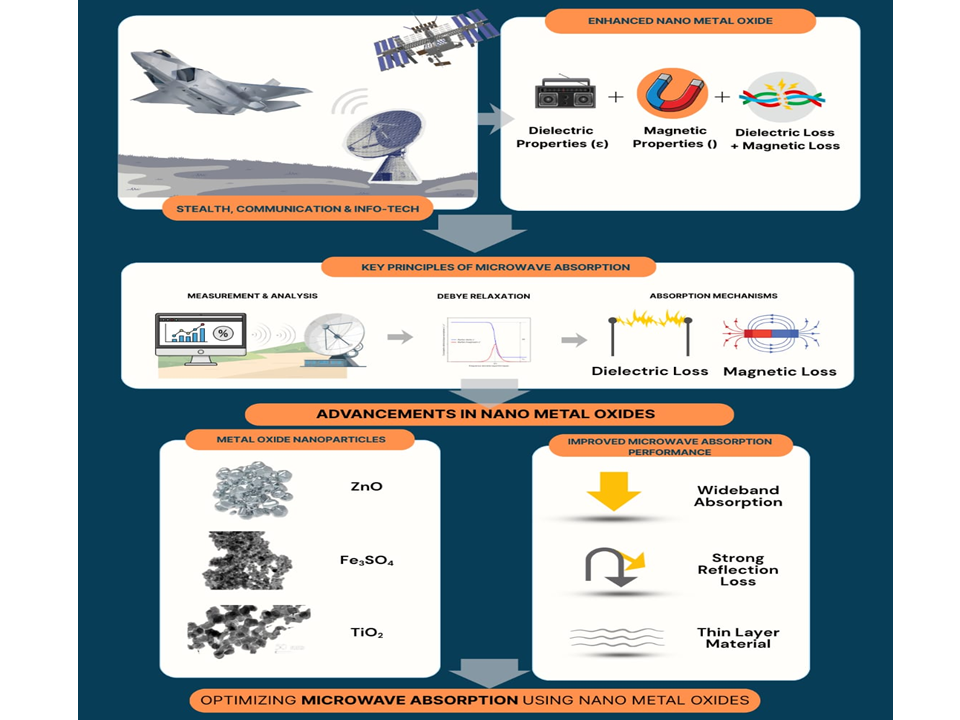
Over the years, microwave-absorbing materials have attracted major interest because of their critical roles in stealth, communication, and information-processing technologies. Advances in nanomaterial functionalization enable tailored dielectric and magnetic properties, with absorption governed by dielectric loss, magnetic loss, and their coupling. The article expounds on measurement principles, encompassing essential analyses, performance assessments, and prevalent interaction pathways like Debye relaxation. Notably, it showcases advancements and evaluates performance in microwave absorption using metal-oxide nanomaterials. This work provides an introduction to the basic principles of microwave absorption and summarizes recent progress in improving the absorption performance of various nanometal oxides.
References
[1] Wang, G., Gao, Z., Tang, S., Chen, C., Duan, F., Zhao, S., Lin, S., Feng, Y., Zhou, L. and Qin, Y. 2012. Microwave absorption properties of carbon nanocoils coated with highly controlled magnetic materials by atomic layer deposition. ACS Nano. 6(12). 11009–11017. Doi: https://doi.org/10.1021/nn304630h
[2] Zhang, L., Shi, C., Rhee, K. Y. and Zhao, N. 2012. Properties of Co0.5Ni0.5Fe2O4/carbon nanotubes/polyimide nanocomposites for microwave absorption. Compos. Part A Appl. Sci. Manuf. 43(12). 2241–2248. Doi: https://doi.org/10.1016/j.compositesa.2012.08.014
[3] Hashemi, S. A., Bahrani, S., Mousavi, S. M., Omidifar, N., Behbahan, N. G. G., Arjmand, M., Ramakrishna, S., Lankarani, K. B., Moghadami, M., Shokripour, M., Firoozsani, M. and Chiang, W. H. 2021. Ultra-precise label-free nanosensor based on integrated graphene with Au nanostars toward direct detection of IgG antibodies of SARS-CoV-2 in blood. J. Electroanal. Chem. 894. 115341. Doi: https://doi.org/10.1016/j.jelechem.2021.115341
[4] Li, N., Huang, G. W., Li, Y. Q., Xiao, H. M., Feng, Q. P., Fu, S. Y. and Ma, C. 2017. Enhanced microwave absorption performance of coated carbon nanotubes by optimizing the Fe3O4 nanocoating structure. ACS Appl. Mater. Interfaces. 9(3). 2973–2983. Doi: https://doi.org/10.1021/acsami.6b13142
[5] Vitharana, M. G., Paul, S. C., Kong, S. Y., Babafemi, A. J., Miah, M. J. and Panda, B. 2020. A study on strength and corrosion protection of cement mortar with the inclusion of nanomaterials. Sustain. Mater. Technol. 25. e00192. Doi: https://doi.org/10.1016/j.susmat.2020.e00192
[6] Ruiz-Caldas, M. X., Carlsson, J., Sadiktsis, I., Jaworski, A., Nilsson, U. and Mathew, A. P. 2022. Cellulose nanocrystals from postconsumer cotton and blended fabrics: A study on their properties, chemical composition, and process efficiency. ACS Sustain. Chem. Eng. 10(11). 3787–3798. Doi: https://doi.org/10.1021/acssuschemeng.2c00797
[7] Li, Y., Meng, G. W., Zhang, L. D. and Phillipp, F. 2000. Ordered semiconductor ZnO nanowire arrays and their photoluminescence properties. Appl. Phys. Lett. 76(15). 2011–2013. Doi: https://doi.org/10.1063/1.126238
[8] Micheli, D., Apollo, C., Pastore, R. and Marchetti, M. 2010. X-Band microwave characterization of carbon-based nanocomposite material, absorption capability comparison and RAS design simulation. Compos. Sci. Technol. 70(2). 400–409. Doi: https://doi.org/10.1016/j.compscitech.2009.11.015
[9] Sharma, G., Kumar, A., Sharma, S., Naushad, M., Dwivedi, R. P., Alothman, Z. A. and Mola, G. T. 2019. Novel development of nanoparticles to bimetallic nanoparticles and their composites: A review. J. King Saud Univ. Sci. 31(2). 257–269. Doi: https://doi.org/10.1016/j.jksus.2017.06.012
[10] Park, H. W., Kim, T., Huh, J., Kang, M., Lee, J. E. and Yoon, H. 2012. Anisotropic growth control of polyaniline nanostructures and their morphology-dependent electrochemical characteristics. ACS Nano. 6(9). 7624–7633. Doi: https://doi.org/10.1021/nn3033425
[11] Tian, H., Xin, F., Wang, X., He, W. and Han, W. 2015. High capacity group-IV elements (Si, Ge, Sn) based anodes for lithium-ion batteries. J. Mater. 1(3). 153–169. Doi: https://doi.org/10.1016/j.jmat.2015.06.002
[12] Yin, P., Zhang, L., Wang, J., Feng, X., Li, Y. and Zhao, L. 2018. The microwave absorbing properties of ZnO/Fe3O4/paraffin composites in low frequency band. Mater. Res. Express. 5(2). 026109. Doi: https://doi.org/10.1088/2053-1591/aaae58
[13] Wang, G., Ong, S. J. H., Zhao, Y., Xu, Z. J. and Ji, G. 2020. Integrated multifunctional macrostructures for electromagnetic wave absorption and shielding. J. Mater. Chem. A. 8(46). 24368–24387. Doi: https://doi.org/10.1039/D0TA08515D
[14] Setua, D. K., Mordina, B., Srivastava, A. K., Roy, D. and Prasad, N. E. 2020. Carbon nanofibers-reinforced polymer nanocomposites as efficient microwave absorber. In: Fiber-Reinforced Nanocomposites: Fundamentals and Applications. Elsevier. 395–430. Doi: https://doi.org/10.1016/B978-0-12-819904-6.00018-9
[15] Li, Q., Mahendra, S., Lyon, D. Y., Brunet, L., Liga, M. V., Li, D. and Alvarez, P. J. J. 2008. Antimicrobial nanomaterials for water disinfection and microbial control: Potential applications and implications. Water Res. 42(18). 4591–4602. Doi: https://doi.org/10.1016/j.watres.2008.08.015
[16] Green, M. and Chen, X. 2019. Recent progress of nanomaterials for microwave absorption. J. Mater. 5(4). 503–541. Doi: https://doi.org/10.1016/j.jmat.2019.07.003
[17] Serhan, M., Jackemeyer, D., Long, M., Sprowls, M., Diez-Perez, I., Maret, W., Chen, F., Tao, N. and Forzani, E. 2020. Total iron measurement in human serum with a novel smartphone-based assay. IEEE J. Transl. Eng. Health Med. 8. 9126819. Doi: https://doi.org/10.1109/JTEHM.2020.3005308
[18] Song, J. H., Min, S. H., Kim, S. G., Cho, Y. and Ahn, S. H. 2022. Multi-functionalization strategies using nanomaterials: A review and case study in sensing applications. Int. J. Precis. Eng. Manuf. Technol. 9(1). 323–347. Doi: https://doi.org/10.1007/s40684-021-00356-1
[19] Mourdikoudis, S., Pallares, R. M. and Thanh, N. T. K. 2018. Characterization techniques for nanoparticles: Comparison and complementarity upon studying nanoparticle properties. Nanoscale. 10(27). 12871–12934. Doi: https://doi.org/10.1039/C8NR02278J
[20] Hassan, H., Sharma, P., Hasan, M. R., Singh, S., Thakur, D. and Narang, J. 2022. Gold nanomaterials–The golden approach from synthesis to applications. Mater. Sci. Energy Technol. 5. 375–390. Doi: https://doi.org/10.1016/j.mset.2022.09.004
[21] Khan, I., Saeed, K. and Khan, I. 2019. Nanoparticles: Properties, applications and toxicities. Arab. J. Chem. 12(7). 908–931. Doi: https://doi.org/10.1016/j.arabjc.2017.05.011
[22] Joudeh, N. and Linke, D. 2022. Nanoparticle classification, physicochemical properties, characterization, and applications: A comprehensive review for biologists. J. Nanobiotechnol. 20(1). 262. Doi: https://doi.org/10.1186/s12951-022-01477-8
[23] Wang, R., Wang, T., Zobeiri, H., Li, D. and Wang, X. 2020. Energy and charge transport in 2D atomic layer materials: Raman-based characterization. Nanomaterials. 10(9). 1807. Doi: https://doi.org/10.3390/nano10091807
[24] Baer, D. R., Gaspar, D. J., Nachimuthu, P., Techane, S. D. and Castner, D. G. 2013. Surface characterization of nanomaterials and nanoparticles: Important needs and challenging opportunities. J. Vac. Sci. Technol. A. 31(5). 050820. Doi: https://doi.org/10.1116/1.4818423
[25] Maity, D., Sahoo, S. R. and Saha, S. 2023. Synthesis and characterization of nanomaterials for electrochemical sensors. In: ACS Symp. Ser. 1437. 193–222. Doi: https://doi.org/10.1021/bk-2023-1437.ch009
[26] Mekuye, B. and Abera, B. 2023. Nanomaterials: An overview of synthesis, classification, characterization, and applications. Nano Sel. 4(8). 486–501. Doi: https://doi.org/10.1002/nano.202300038
[27] Hossain, N., Rahman, M. M., Sarker, M. S. I., Nishu, M. H., Khandaker, M. U., Alsubaie, A., Bradley, D. A. and Emran, T. B. 2023. Advances and significances of nanoparticles in semiconductor applications – A review. Results Eng. 19. 101347. Doi: https://doi.org/10.1016/j.rineng.2023.101347
[28] Yang, C. C., Gung, Y. J., Hung, W. C., Ting, T. H. and Wu, K. H. 2010. Infrared and microwave absorbing properties of BaTiO3/polyaniline and BaFe12O19/polyaniline composites. Compos. Sci. Technol. 70(3). 466–471. Doi: https://doi.org/10.1016/j.compscitech.2009.11.021
[29] Kong, L., Yin, X., Zhang, L. and Cheng, L. 2012. Effect of aluminum doping on microwave absorption properties of ZnO/ZrSiO4 composite ceramics. J. Am. Ceram. Soc. 95(10). 3158–3165. Doi: https://doi.org/10.1111/j.1551-2916.2012.05278.x
[30] Ge, C., Zhang, X., Liu, J., Jin, F., Liu, J. and Bi, H. 2016. Hollow-spherical composites of polyaniline/cobalt sulfide/carbon nanodots with enhanced magnetocapacitance and electromagnetic wave absorption capabilities. Appl. Surf. Sci. 378. 49–56. Doi: https://doi.org/10.1016/j.apsusc.2016.03.210
[31] Cai, M., Shui, A., Wang, X., He, C., Qian, J. and Du, B. 2020. A facile fabrication and high-performance electromagnetic microwave absorption of ZnO nanoparticles. J. Alloys Compd. 842. 155638. Doi: https://doi.org/10.1016/j.jallcom.2020.155638
[32] Thomas, P., Abdulhakim, L. V., Pushkaran, N. K. and Karuvandi, A. C. 2020. Wideband radar absorbing structure using polyaniline-graphene nanocomposite. C. 6(4). 72. Doi: https://doi.org/10.3390/c6040072
[33] Aherrao, D. S., Singh, C. and Srivastava, A. K. 2022. Review of ferrite-based microwave-absorbing materials: Origin, synthesis, morphological effects, dielectric/magnetic properties, composites, absorption mechanisms, and optimization. J. Appl. Phys. 132(24). Doi: https://doi.org/10.1063/5.0123263
[34] Hou, T., Zhang, L., Wang, J., Li, T., Zhang, Z. and Qu, Y. 2019. A review of metal oxide-related microwave absorbing materials from the dimension and morphology perspective. J. Mater. Sci. Mater. Electron. 30(12). 10961–10984. Doi: https://doi.org/10.1007/s10854-019-01537-0
[35] Elmahaishi, M. F., Azis, R. S., Ismail, I. and Muhammad, F. D. 2022. A review on electromagnetic microwave absorption properties: Their materials and performance. J. Mater. Res. Technol. 20. 2188–2220. Doi: https://doi.org/10.1016/j.jmrt.2022.07.140
[36] Wang, B., Wu, Q., Fu, Y. and Liu, T. 2021. A review on carbon/magnetic metal composites for microwave absorption. J. Mater. Sci. Technol. 86. 91–109. Doi: https://doi.org/10.1016/j.jmst.2020.12.078
[37] von Hippel, A. R. and Morgan, S. O. 1955. Dielectric materials and applications. J. Electrochem. Soc. 102(3). 68C. Doi: https://doi.org/10.1149/1.2430014
[38] Singh, V. K., Shokouhimehr, M., Kim, S. Y., Jang, H. S., Lee, J. H. and Nah, C. 2012. Microwave absorbing properties of a thermally reduced graphene oxide/nitrile butadiene rubber composite. Carbon. 50(6). 2202–2208. Doi: https://doi.org/10.1016/j.carbon.2012.01.033
[39] Liu, Z., Bai, G., Huang, Y., Ma, Y., Du, F., Li, F., Guo, T., Chen, Y. and Zhou, Z. 2007. Microwave absorption of single-walled carbon nanotubes/soluble cross-linked polyurethane composites. J. Phys. Chem. C. 111(37). 13696–13700. Doi: https://doi.org/10.1021/jp0731396
[40] Zeng, X., Cheng, X., Yu, R. and Stucky, G. D. 2020. Electromagnetic microwave absorption theory and recent achievements in microwave absorbers. Carbon. 168. 606–623. Doi: https://doi.org/10.1016/j.carbon.2020.07.028
[41] Zhang, H. and Wallmark, O. 2017. Limitations and constraints of eddy-current loss models for interior permanent-magnet motors with fractional-slot concentrated windings. Energies. 10(3). 379. Doi: https://doi.org/10.3390/en10030379
[42] Hu, J., Du, Y., Zhang, J., Ji, H., Liu, S. and Li, W. 2011. γ-MnO2/polyaniline composites: Preparation, characterization, and applications in microwave absorption. Phys. B Condens. Matter. 406(10). 1950–1955. Doi: https://doi.org/10.1016/j.physb.2011.02.063
[43] Gao, W. and Li, Z. 2009. Nanostructures of zinc oxide. Int. J. Nanotechnol. 6(3–4). 245–255. Doi: https://doi.org/10.1504/IJNT.2009.022917
[44] Mallakpour, S., Sirous, F. and Hussain, C. M. 2021. A journey to the world of fascinating ZnO nanocomposites made of chitosan, starch, cellulose, and other biopolymers: Progress in recent achievements in eco-friendly food packaging, biomedical, and water remediation technologies. Int. J. Biol. Macromol. 170. 701–716. Doi: https://doi.org/10.1016/j.ijbiomac.2020.12.163
[45] Li, H., Liu, L., Yang, F. and Wang, X. 2010. Directed growth and microwave absorption property of crossed ZnO netlike micro-/nanostructures. J. Phys. Chem. C. 114(22). 10088–10091. Doi: https://doi.org/10.1021/jp100341h
[46] Kumar, S., Kumar, M. and Singh, A. 2021. Synthesis and characterization of iron oxide nanoparticles (Fe2O3, Fe3O4): A brief review. Contemp. Phys. 62(3). 144–164. Doi: https://doi.org/10.1080/00107514.2022.2080910
[47] Adi, W. A. and Yunasfi. 2020. Magnetic properties and microwave absorption characteristic of MWNT filled with magnetite coated iron nanoparticles. Mater. Sci. Eng. B. 262. 114760. Doi: https://doi.org/10.1016/j.mseb.2020.114760
[48] Jian, S., Tian, Z., Hu, J., Zhang, K., Zhang, L., Duan, G., Yang, W. and Jiang, S. 2022. Enhanced visible light photocatalytic efficiency of La-doped ZnO nanofibers via electrospinning-calcination technology. Adv. Powder Mater. 1(2). 100004. Doi: https://doi.org/10.1016/j.apmate.2021.09.004
[49] Tong, G., Du, F., Wu, W., Wu, R., Liu, F. and Liang, Y. 2013. Enhanced reactive oxygen species (ROS) yields and antibacterial activity of spongy ZnO/ZnFe2O4 hybrid micro-hexahedra selectively synthesized through a versatile glucose-engineered co-precipitation/annealing process. J. Mater. Chem. B. 1(20). 2647–2657. Doi: https://doi.org/10.1039/C3TB20229A
[50] Li, Y., Zhao, B., Fan, S., Liang, L., Zhou, Y., Wang, R., Guo, X., Fan, B. and Zhang, R. 2019. ZnO amounts-dependent electromagnetic wave absorption capabilities of Ni/ZnO composite microspheres. J. Mater. Sci. Mater. Electron. 30(22). 19966–19976. Doi: https://doi.org/10.1007/s10854-019-02363-0
[51] Zhang, J., Gao, L., He, Z., Hou, X., Zhan, W. and Pang, Q. 2020. Separation and recovery of iron and nickel from low-grade laterite nickel ore by microwave carbothermic reduction roasting. J. Mater. Res. Technol. 9(6). 12223–12235. Doi: https://doi.org/10.1016/j.jmrt.2020.08.036
Downloads
Published
How to Cite
Issue
Section
License
Copyright (c) 2026 Sorption Studies

This work is licensed under a Creative Commons Attribution-ShareAlike 4.0 International License.