Comparative Heavy Metal Adsorption Using Magnetic, Carbon-Based, and Biopolymer Composite: A Critical Systematic Review
DOI:
https://doi.org/10.55749/ss.v2i1.152Keywords:
Adsorption, Biopolymer, Carbon-based material, Heavy metal, Magnetic compositeAbstract
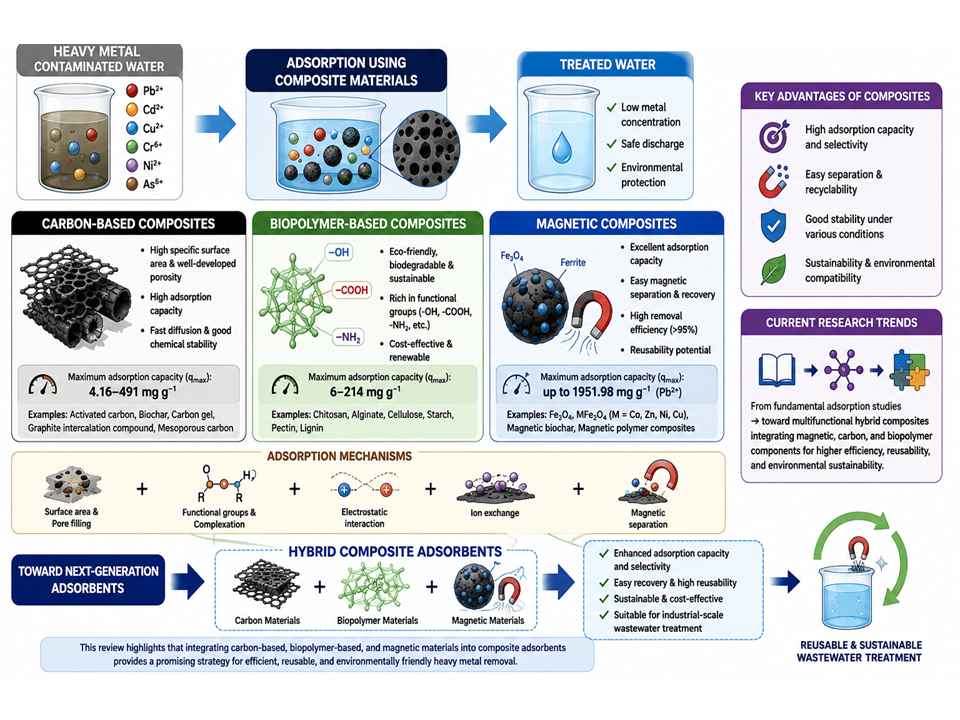
The increasing contamination of aquatic environments by heavy metals has driven the continuous development of efficient, sustainable, and reusable adsorbent materials. This systematic review critically compares the adsorption performance of magnetic-, carbon-based-, and biopolymer-based composites used for heavy metal removal from aqueous solutions. The analysis integrates data from various studies published within the last decade, focusing on maximum adsorption capacity (qmax), specific surface area, magnetic properties, and adsorption isotherm models. Carbon-based adsorbents demonstrate high adsorption capacities (4.16–491 mg g⁻¹) due to their large surface areas and well-developed porosity, while biopolymer-based materials offer environmental sustainability and functional group diversity but generally exhibit lower adsorption performance unless modified with magnetic or carbon components. Magnetic adsorbents, particularly ferrite-based nanocomposites, exhibit exceptional adsorption capacities (up to 1951.98 mg g⁻¹ for Pb(II)) and high removal efficiencies exceeding 95%, with the added advantage of easy magnetic separation and recyclability. However, the long-term stability and regeneration efficiency of magnetic adsorbents remain critical challenges. The bibliometric analysis using VOSviewer further reveals that recent research trends are shifting from fundamental adsorption studies toward the development of multifunctional, hybrid composites that integrate magnetic, carbon, and biopolymer components. These advancements reflect a growing emphasis on enhancing adsorption efficiency, reusability, and environmental compatibility, providing a strong foundation for the design of next-generation adsorbents suitable for industrial-scale wastewater treatment.
References
[1] Sekarwati, N. and Murachman, B. 2014. Dampak logam berat Cu (Tembaga) dan Ag (Perak) pada limbah cair industri perak terhadap kualitas air sumur dan kesehatan masyarakat serta upaya pengendaliannya di Kota Gede Yogyakarta. Ekosains. 7(1). Doi: https://doi.org/10.47317/JKM.V9I1.242
[2] Rasmito, A. 2018. Penurunan kadar logam berat limbah cair industri emas dengan kaustik soda. JTIK. 1(2). 16–29. Doi: https://doi.org/10.54980/jtik.v1i2.27
[3] Kusumawati, E., Jayanti, R.D., Putri, L.H., Annisa, N. and Paramitha, T. 2024. Evaluasi dan modifikasi alat penukar ion dengan penambahan kolom adsorpsi karbon aktif untuk menurunkan kesadahan. Kovalen. 10(1). 1–10. Doi: https://doi.org/10.22487/kovalen.2024.v10.i1.16556
[4] Susanty, S. and Bachmid, F. 2016. Perbandingan Metode Ekstraksi Maserasi dan Refluks terhadap Kadar fenolik dari ekstrak tongkol jagung (Zea mays L.). J. Konversi. 5(2). 87–92. Doi: https://doi.org/10.24853/konversi.5.2.87-92
[5] Takarani, P., Novita, S.F. and Fathoni, R.A. 2019. Pengaruh massa dan waktu adsorben selulosa dari kulit jagung terhadap konsentrasi penyerapan. Semin. Nas. Rekayasa Trop. 2(1). 117–121.
[6] Samadi, A., Wang, Z., Wang, S., Nataraj, S.K., Kong, L. and Zhao, S. 2023. Polyaniline-Based adsorbents for water treatment: roles of low-cost materials and 2D materials. Chem. Eng. J. 478. 147506. Doi: https://doi.org/10.1016/j.cej.2023.147506
[7] Bao, S., Yang, W., Wang, Y., Yu, Y. and Sun, Y. 2020. One-Pot synthesis of magnetic graphene oxide composites as an efficient and recoverable adsorbent for cd(ii) and pb(ii) removal from aqueous solution. J. Hazard. Mater. 381. 120914. Doi: https://doi.org/10.1016/j.jhazmat.2019.120914
[8] Luo, X., Lei, X., Cai, N., Xie, X., Xue, Y. and Yu, F. 2016. Removal of heavy metal ions from water by magnetic cellulose-based beads with embedded chemically modified magnetite nanoparticles and activated carbon. ACS Sustain. Chem. Eng. 4(7). 3960–3969. Doi: https://doi.org/10.1021/acssuschemeng.6b00790
[9] Zheng, X., Zheng, H., Xiong, Z., Zhao, R., Liu, Y., Zhao, C. and Zheng, C. 2020. Novel anionic polyacrylamide-modify-chitosan magnetic composite nanoparticles with excellent adsorption capacity for cationic dyes and pH-independent adsorption capability for metal Ions. Chem. Eng. J. 392. 123706. Doi: https://doi.org/10.1016/j.cej.2019.123706
[10] Awad, A.M., Jalab, R., Benamor, A., Nasser, M.S., Ba-Abbad, M.M., El-Naas, M. and Mohammad, A.W. 2020. Adsorption of organic pollutants by nanomaterial-based adsorbents: an overview. J. Mol. Liq. 301. 112335. Doi: https://doi.org/10.1016/j.molliq.2019.112335
[11] Zhai, L., Zheng, X., Liu, M., Wang, X., Li, W., Zhu, X., Yuan, A., Xu, Y. and Song, P. 2023. Tuning surface functionalizations of uio-66 towards high adsorption capacity and selectivity eliminations for heavy metal ions. Chem. Eng. J. 154. 110937. Doi: https://doi.org/10.1016/j.inoche.2023.110937
[12] Song, M., Wei, Y., Cai, S., Yu, L., Zhong, Z. and Jin, B. 2018. Study on adsorption properties and mechanism of Pb²⁺ with different carbon-based adsorbents. Sci. Total Environ. 618. 1416–1422. Doi: https://doi.org/10.1016/j.scitotenv.2017.09.268
[13] Lee, C.G., Jeon, J.W., Hwang, M.J., Ahn, K.H., Park, C., Choi, J.W. and Lee, S.H. 2015. Lead and copper removal from aqueous solutions using carbon foam derived from phenol resin. Chemosphere. 130. 59–65. Doi: https://doi.org/10.1016/j.chemosphere.2015.02.055
[14] Fu, R., Liu, Y., Lou, Z., Wang, Z., Baig, S.A. and Xu, X. 2016. Adsorptive removal of Pb(II) by magnetic activated carbon incorporated with amino groups from aqueous solutions. J. Taiwan Inst. Chem. Eng. 62. 247–258. Doi: https://doi.org/10.1016/j.jtice.2016.02.012
[15] Natrayan, L., Kaliappan, S., Dheeraj Kumar Reddy, C.N., Karthick, M., Sivakumar, N.S., Patil, P.P., Sekar, S. and Thanappan, S. 2022. Development and characterization of carbon-based adsorbents derived from agricultural wastes and their effectiveness in adsorption of heavy metals in waste water. Bioinorg. Chem. Appl. 2022. Doi: https://doi.org/10.1155/2022/1659855
[16] Osińska, M. 2017. Removal of Lead(II), Copper(II), Cobalt(II) and Nickel(II) ions from aqueous solutions using carbon gels. J. Sol-Gel Sci. Technol. 81(3). 678–692. Doi: https://doi.org/10.1007/s10971-016-4256-0
[17] Anbia, M. and Haqshenas, M. 2015. Adsorption studies of Pb(II) and Cu(II) ions on mesoporous carbon nitride functionalized with melamine-based dendrimer amine. Int. J. Environ. Sci. Technol. 12(8). 2649–2664. Doi: https://doi.org/10.1007/s13762-015-0776-3
[18] Barczak, M., Michalak-Zwierz, K., Gdula, K., Tyszczuk-Rotko, K., Dobrowolski, R. and Dąbrowski, A. 2015. Ordered mesoporous carbons as effective sorbents for removal of heavy metal ions. Microporous Mesoporous Mater. 211. 162–173. Doi: https://doi.org/10.1016/j.micromeso.2015.03.010
[19] Hassan, M., Liu, Y., Naidu, R., Du, J., Qi, F., Donne, S.W. and Islam, M.M. 2021. Mesoporous biopolymer architecture enhanced the adsorption and selectivity of aqueous heavy-metal ions. ACS Omega. 6(23). 15316–15331. Doi: https://doi.org/10.1021/acsomega.1c01642
[20] Irfan, M., Arif, A., Munir, M.A., Naz, M.Y., Shukrullah, S., Rahman, S., Jalalah, M. and Almawgani, A.H.M. 2023. Statistically analyzed heavy metal removal efficiency of silica-coated Cu0.5Mg0.5Fe2O4 magnetic adsorbent for wastewater treatment. ACS Omega. 8(50). 47623–47634. Doi: https://doi.org/10.1021/acsomega.3c05764
[21] Katubi, K.M.M., Alsaiari, N.S., Alzahrani, F.M., Siddeeg, S.M. and Tahoon, M.A. 2021. Synthesis of manganese ferrite/graphene oxide magnetic nanocomposite for pollutants removal from water. Processes. 9(4). Doi: https://doi.org/10.3390/pr9040589
[22] Hassan, A.A., Fahim, Y.A. and Ali, M.E.M. 2025. Efficient removal of Cr(VI) and As(V) from aqueous solution using magnetically separable nickel ferrite nanoparticles. J. Cluster Sci. 36(4). Doi: https://doi.org/10.1007/s10876-024-02736-4
[23] Ansari, S.M., Kashid, V., Sinha, B.B., Sen, D., Kolekar, Y.D. and Ramana, C.V. 2023. Synthesis, characterization and performance evaluation of magnetic nanostructured CoFe2O4 for adsorption removal of Contaminant Heavy Metal Ions. Appl. Ferrites. Doi: https://doi.org/10.5772/intechopen.1002349
[24] Busroni, Anwar, C. and Santosa, S.J. 2023. Penjerapan Kation Fe³⁺ dan Pb²⁺ Menggunakan TBKA dan TBMTKA sebagai bahan penjerap: kajian variasi pH, kapasitas adsorpsi, dan waktu kontak. Indones. J. Chem. 24(1). 50–57. Doi: https://doi.org/10.55981/jtl.2023.242
[25] Perdana, A., Zarkasi, A., Hamdani, D., Inu Natalisanto, A., Munir, R., Barong Tongkok, J., Kelua, G., Samarinda Ulu, K. and Timur, K. 2023. Karakteristik adsorben ampas teh dalam menyerap ion logam timbal menggunakan model isoterm langmuir. J. Ilmu Inov. Fis. 7(1). Doi: https://doi.org/10.24198/jiif.v7i1.42746
[26] Ramadhan, M.D., Iriany, Misran, E. and Turmuzi, M. 2021. Studi model isoterm adsorpsi kristal violet oleh biosorben kulit ubi kayu (Manihot esculenta). J. Tek. Kim. USU. 10(1). 38–44. Doi: https://doi.org/10.32734/jtk.v10i1.5485
[27] Nurhidayati, I., Enriyani, R. and Maimulyanti, A. 2020. Pengaruh pH, waktu kontak, dan kecepatan pengadukan pada adsorpsi fosfat oleh sedimen. J. Ris. Kim. 44(1). 16–19.
[28] Santhosh, C., Kollu, P., Felix, S., Velmurugan, V., Jeong, S.K. and Grace, A.N. 2015. CoFe2O4 and NiFe2O4@graphene adsorbents for heavy metal ions: kinetic and thermodynamic analysis. RSC Adv. 5(37). 28965–28972. Doi: https://doi.org/10.1039/c5ra02905h
[29] Saraswati, N.L.P.A. 2022. Pengaruh suhu aktivasi arang terhadap kondisi equilibrium dan parameter termodinamika adsorpsi senyawa remazol red. J. Kim. 16(3). 40–47. Doi: https://doi.org/10.23887/wms.v16i3.54629
[30] Alkherraz, A.M., Ali, A.K. and Elsherif, K.M. 2020. Removal of Pb(II), Zn(II), Cu(II) and Cd(II) from aqueous solutions by adsorption onto olive branches activated carbon: equilibrium and thermodynamic studies. Sci. Rev. Chem. Commun. 1. 11–20. Doi: https://doi.org/10.5281/zenodo.2579465
[31] Zare-Dorabei, R., Ferdowsi, S.M., Barzin, A. and Tadjarodi, A. 2016. Highly efficient simultaneous ultrasonic-assisted adsorption of Pb(II), Cd(II), Ni(II) and Cu(II) ions from aqueous solutions by graphene oxide modified with 2,2′-Dipyridylamine: central composite design optimization. Ultrason. Sonochem. 32. 265–276. Doi: https://doi.org/10.1016/j.ultsonch.2016.03.020
[32] Hamza, M.F., Hamad, N.A., Hamad, D.M., Khalafalla, M.S., Abdel-Rahman, A.A.H., Zeid, I.F., Wei, Y., Hessien, M.M., Fouda, A. and Salem, W.M. 2021. Synthesis of eco-friendly biopolymer alginate-chitosan composite to adsorb the heavy metals Cd(II) and Pb(II) from contaminated effluents. Materials. 14(9). Doi: https://doi.org/10.3390/ma14092189
[33] Shokri, E., Khanghahi, B., Esmizadeh, E. and Etemadi, H. 2022. Biopolymer-based adsorptive membrane for simultaneous removal of cationic and anionic heavy metals from water. Int. J. Environ. Sci. Technol. 19(5). 4167–4180. Doi: https://doi.org/10.1007/s13762-021-03592-9
[34] Beyki, M.H., Miri, S., Shemirani, F., Bayat, M. and Ranjbar, P.R. 2016. A New derivative of core-shell magnetic chitosan biopolymer: synthesis, characterization and application for adsorption of lead and copper ions. Clean Soil Air Water. 44(6). 710–719. Doi: https://doi.org/10.1002/clen.201400244
[35] Güney, B.C. and Arslan, Y. 2023. Removal of Cu(II) by biopolymer-clay nanocomposite adsorbent. React. Kinet. Mech. Catal. 136(1). 433–448. Doi: https://doi.org/10.1007/s11144-022-02340-5
[36] Manimozhi, V., Saravanathamizhan, R., Sivakumar, E.K.T. and Jaisankar, V. 2020. Adsorption study of heavy metals removal from wastewater using PVA-nano ferrite composites. Int. J. Nanosci. Nanotechnol. 16(3). 189–200.
[37] Vicente-Martínez, Y., Arroniz-Lázaro, A., Hernández-Córdoba, M. and López-García, I. 2024. Use of in-situ synthesized magnetic ferrite to remove heavy metals from waters. Green Anal. Chem. 8. Doi: https://doi.org/10.1016/j.greeac.2023.100089
[38] Mokif, L.A., Obaid, Z.H. and Juda, S.A. 2024. Synthesis of new composite adsorbents for removing heavy metals and dyes from aqueous solution. J. Ecol. Eng. 25(6). 164–179. Doi: https://doi.org/10.12911/22998993/187148
Downloads
Published
How to Cite
Issue
Section
License
Copyright (c) 2026 Sorption Studies

This work is licensed under a Creative Commons Attribution-ShareAlike 4.0 International License.