Differential expression of flavone synthase in Bidens pilosa tissues and its relevance to antioxidant-based CBRNE mitigation strategies
DOI:
https://doi.org/10.55749/cds.v1i1.181Keywords:
Bidens pilosa L., Biosynthesis, Flavone synthase, Gene expression, Real-time PCRAbstract
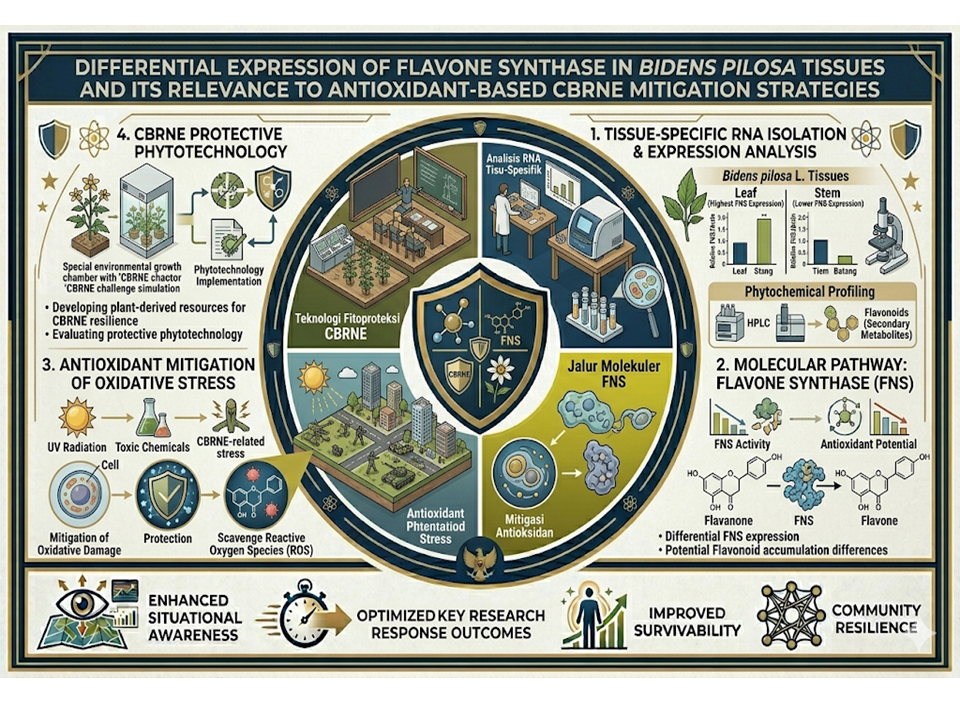
Flavone synthase (FNS) is a key enzyme involved in the conversion of flavanones into flavones, a class of secondary metabolites that contribute to plant defense through their antimicrobial and antioxidant properties. These bioactive compounds play an important role in mitigating oxidative stress induced by environmental factors, including ultraviolet (UV) radiation and other stressors relevant to Chemical, Biological, Radiological, Nuclear, and Explosives (CBRNE) scenarios. Bidens pilosa L. is a herbaceous plant recognized for its rich flavonoid content, particularly in its leaves and stems, making it a promising source of bioactive phytochemicals. This study aimed to evaluate tissue-specific FNS gene expression in B. pilosa to assess its flavonoid biosynthetic potential and its prospective relevance to CBRNE protective phytotechnology. Total RNA was isolated from fresh leaf and stem tissues using the phenol–chloroform method, followed by cDNA synthesis through reverse transcription. Gene expression analysis was conducted using real-time quantitative PCR (RT-qPCR), with FNS as the target gene and actin as the reference gene. The results revealed differential FNS expression between leaf and stem tissues, indicating variations in flavonoid biosynthesis and potential flavonoid accumulation. These findings provide a molecular basis for evaluating flavonoid-producing capacity in B. pilosa and support the exploration of plant-derived antioxidant resources for future applications in protective phytotechnology and resilience against oxidative stress associated with CBRNE-related environmental challenges.
References
[1] Idris, O.A., Kerebba, N., Horn, S., Maboeta, M.S. and Pieters, R. 2023. Phytochemical-based evidence of the health benefits of Bidens pilosa extracts and cytotoxicity. Chem. Afr. 6(4). 1767-1788. Doi: https://doi.org/10.1007/s42250-023-00626-2
[2] Martens, S. and Mithöfer, A. 2005. Flavones and flavone synthases. Phytochemistry. 66(20). 2399-2407. Doi: https://doi.org/10.1016/j.phytochem.2005.07.013
[3] Zeng, G., Wang, Y., Zhu, M., Yi, J., Ma, J., Yang, B., Sun, W., Dai, F., Yin, J. and Zeng, G. 2024. Inhibition of DNA Topoisomerase Ι by Flavonoids and Polyacetylenes Isolated from Bidens pilosa L. Molecules. 29(15). 3547. Doi: https://doi.org/10.3390/molecules29153547
[4] Zhu, M., Xiong, J., Zhang, R., Yang, X., Sun, W., Yang, Z., Chai, Y., Tao, Y., Zhao, Y.Q., Fan, B. and Zeng, G., 2026. Cancer immunomodulatory effect of Bidens pilosa L. in mice: suppression of tumor-associated macrophages and regulatory T cells. Cells. 15(2). 126. Doi: https://doi.org/10.3390/cells15020126
[5] Chatri, M., Jumjunidang, J., Aini, Z. and Suryendra, F.D. 2022. Aktivitas antifungi ekstrak daun Melastoma malabathricum terhadap Fusarium oxysporum dan Sclerotium rolfsii secara in vitro. J. Agrotek Trop. 10(3). 395-401. Doi: https://doi.org/10.23960/jat.v10i3.5713
[6] Arsy, F.S., Chatri, M., Irdawati., and Des. 2023. Pemanfaatan flavonoid sebagai bahan pestida nabati. J. Embrio. 15(1). 36-45. Doi: https://doi.org/10.31317/embrio.v15i1.884
[7] Zoratti, L., Karppinen, K., Luengo Escobar, A., Häggman, H. and Jaakola, L., 2014. Light-controlled flavonoid biosynthesis in fruits. Front. Plant Sci. 5. 534. Doi: https://doi.org/10.3389/fpls.2014.00534
[8] Bagnoli, E., Lin, Y.E., Burel, S., Jaimon, E., Antico, O., Themistokleous, C., Nikoloff, J.M., Squires, S., Morella, I., Watzlawik, J.O. and Fiesel, F.C. 2025. Endogenous LRRK2 and PINK1 function in a convergent neuroprotective ciliogenesis pathway in the brain. Proc. Natl. Acad. Sci. U.S.A. 122(5). e2412029122. Doi: https://doi.org/10.1073/pnas.2412029122
[9] Chovancova, P., Merk, V., Marx, A., Leist, M. and Kranaster, R. 2017. Reverse-transcription quantitative PCR directly from cells without RNA extraction and without isothermal reverse-transcription: a ‘zero-step’RT-qPCR protocol. Biol. Methods Protoc. 2(1). bpx008. Doi: https://doi.org/10.1093/biomethods/bpx008
[10] Lixiang, F., Rongqian, Z., Zhang, K. and Yang, W. 2025. Comparison of the 2-CT method and the 2-ΔΔCT method for real-time qPCR data analysis. BioRxiv. 2025-07. Doi: https://doi.org/10.1101/2025.07.16.665089
[11] Rao, X., Huang, X., Zhou, Z. and Lin, X. 2013. An improvement of the 2ˆ (–delta delta CT) method for quantitative real-time polymerase chain reaction data analysis. Biostat. Bioinforma. Biomath. 3(3). 71–85. Doi:
[12] Ma, D., Guo, Y., Ali, I., Lin, J., Xu, Y. and Yang, M. 2024. Accumulation characteristics of plant flavonoids and effects of cultivation measures on their biosynthesis: A review. Plant Physiol. Biochem. 215. 108960. Doi: https://doi.org/10.1016/j.plaphy.2024.108960
[13] Cao, Y., Mei, Y., Zhang, R., Zhong, Z., Yang, X., Xu, C., Chen, K. and Li, X. 2024. Transcriptional regulation of flavonol biosynthesis in plants. Hortic. Res. 11(4). uhae043. Doi: https://doi.org/10.1093/hr/uhae043
[14] Krishnan, R., Qadiri, S.S.N., Kim, J.O., Kim, J.O. and Oh, M.J. 2019. Validation of housekeeping genes as candidate internal references for quantitative expression studies in healthy and nervous necrosis virus-infected seven-band grouper (Hyporthodus septemfasciatus). Fish. Aquat. Sci. 22(1). 28.). Doi: https://doi.org/10.1186/s41240-019-0142-3
[15] Annisa, R. Pengaruh Pestisida Nabati Ekstrak Gulma Ajeran (Bidens pilosa L.) dan Kulit Jeruk Nipis (Citrus aurantiifolia) terhadap Serangan Ulat Grayak (Spodoptera litura Fabricius) dan Pertumbuhan Tanaman Selada (Lactuca sativa L. var. Grand Rapids). 2022. Bachelor’s Thesis, UIN Sunan Gunung Djati Bandung, Bandung, Indonesia.
Downloads
Published
How to Cite
Issue
Section
License
Copyright (c) 2026 CBRNE Defense Studies

This work is licensed under a Creative Commons Attribution-ShareAlike 4.0 International License.