In vitro characterization of banana cultivar rejang responses to Fusarium oxysporum f. sp. cubense tropical race 4 for agricultural biosecurity risk assessment
DOI:
https://doi.org/10.55749/cds.v1i1.174Keywords:
Foc TR4, Fusarium wilt, In vitro culture, PR genes expression, Rejang, SIX genes expressionAbstract
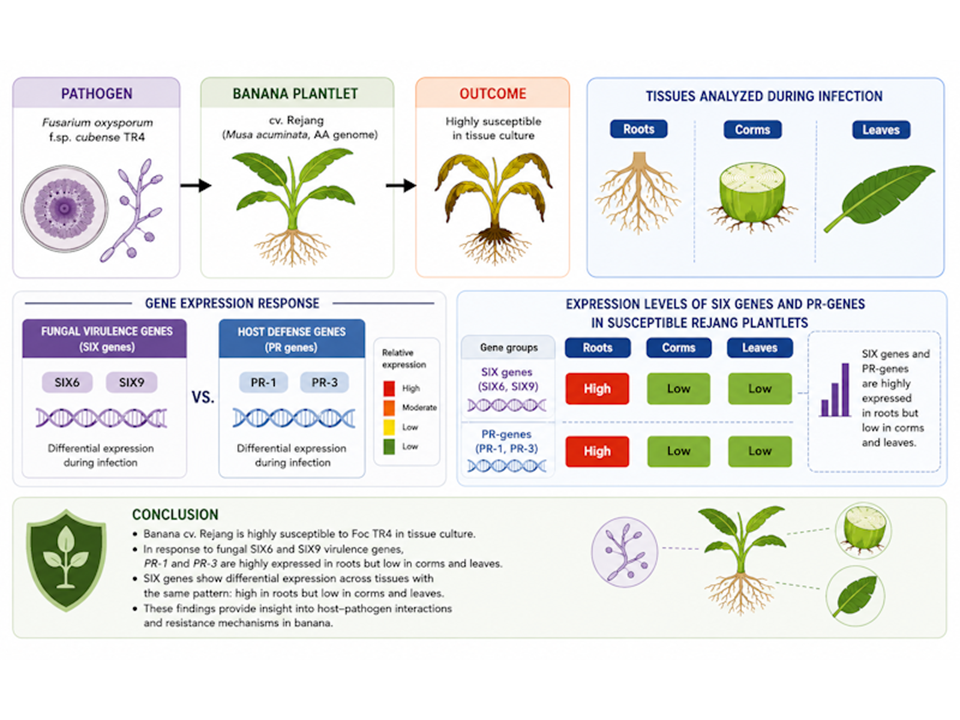
Fusarium oxysporum is a highly destructive soilborne pathogen comprising more than 100 host-specific strains (formae speciales), making it a significant biosecurity threat to many economically important crops, including tomato, melon, cotton, and banana. Its detrimental impact on agricultural productivity poses serious challenges to food security and the sustainability of major agricultural commodities. Understanding the infection mechanism of Fusarium oxysporum f.sp. cubense Tropical Race 4 (Foc TR4) and the defense responses of banana plants against this pathogen is essential for developing effective disease management strategies and enhancing resistance to Fusarium wilt. This study aimed to analyze the expression of the fungal virulance genes SIX6 and SIX9, as well as pathogenesis related genes PR-1 and PR-3, in the roots, corms, and leaves of banana plants infected with Foc TR4. The results showed that tissue-cultured banana cv. Rejang was highly susceptible to Foc TR4 infection. In this susceptible cultivar, the expression of pathogenesis-related genes (PR-1 and PR-1) was markedly elevated in roots in response to the expression of virulence expressing genes (SIX6 and SIX9), whereas lower expression levels were observed in corms and leaves. These findings provide valuable insights into the interaction between Foc TR4 and banana defense mechanisms and may serve as a foundation for the development of Fusarium wilt-resistant banana cultivars, thereby contributing to agricultural biosecurity and food security.
References
[1] Nugraha, A.A., Darsono, D., & Marwanti, S. 2023. Analysis of indonesian banana export performance in major export destination countries. SVU-International J. Agric. Sci. 5(2). 127–136. Doi: https://doi.org/10.21608/svuijas.2023.219439.1294
[2] Badan Pusat Statistik Indonesia. 2025. Produksi Tanaman Buah-buahan dan Sayuran Tahunan Menurut Provinsi dan Jenis Tanaman. https://www.bps.go.id (accessed May 19, 2026).
[3] Han, S., Zhao, P., Wang, M., Jiang, X., Liu, F., Huang, J., & Cai, L. 2025. What is Fusarium forma specialis? Mycology. 16(4). 1522–1557. Doi: https://doi.org/10.1080/21501203.2025.2528352
[4] Manti, I. 2021. Penyebaran dan tingkat serangan penyakit layu pada tanaman pisang di kabupaten bengkulu selatan, in Seminar Nasional Hortikultura, 2021, 143–147.
[5] Nani, M., Harahap, E.O.R., Khastini, R.O., & Ahmad, F. 2023. Detection of fusarium wilt on local bananas in Pandeglang. J. Fitopatol. Indones. 19(4). 133–144. Doi: https://doi.org/10.14692/jfi.19.4.133
[6] Mirayanti Kusuma, A., Rostaman, R., & K, M. 2020. Penyakit pada tanaman pisang dan distribusinya di wilayah kecamatan subang kabupaten banyumas. Agro Wiralodra. 3(1). 8–15.
[7] Arif, W., Widiastuti, A., Indarti, S., Prakoso, A.B., Subandiyah, S., & Sumardiyono, C. 2021. panama disease of banana, identification, epidemiology and management: the indonesian experience.
[8] Yu, D.S. et al. 2024. The structural repertoire of Fusarium oxysporum f.sp. lycopersici effectors revealed by experimental and computational studies. Elife. 12. 1–27. Doi: https://doi.org/10.7554/elife.89280
[9] Widinugraheni, S. et al. 2018. A SIX1 Homolog in Fusarium oxysporum f.sp. cubense Tropical Race 4 Contributes to Virulence towards Cavendish Banana. PLoS One. 13(10). 1–12. Doi: https://doi.org/10.1371/journal.pone.0205896
[10] Jangir, P., Mehra, N., Sharma, K., Singh, N., Rani, M., & Kapoor, R. 2021. Secreted in Xylem Genes: Drivers of Host Adaptation in Fusarium oxysporum. Front. Plant Sci. 12. 1–17. Doi: https://doi.org/10.3389/fpls.2021.628611
[11] An, B., Hou, X., Guo, Y., Zhao, S., Luo, H., He, C., & Wang, Q. 2019. The Effector SIX8 is Required for Virulence of Fusarium oxysporum f.sp. cubense Tropical Race 4 to Cavendish Banana. Fungal Biol. 123(5). 423–430. Doi: https://doi.org/10.1016/j.funbio.2019.03.001
[12] Luis David, M.-B. 2018. Secreted in Xylem (Six) Genes in Fusarium oxysporum f.sp. cubense and Their Potential Acquisition by Horizontal Transfer. Adv. Biotechnol. Microbiol. 10(1). Doi: https://doi.org/10.19080/aibm.2018.10.555779
[13] Farah, N., Belaffif, M.B., Aryantha, I.N.P., & Esyanti, R.R. 2021. SIX6 Shows High Divergence in Fusarium oxysporum f.sp. cubense TR4. Int. J. Agric. Biol. 25(6). 1331–1338. Doi: https://doi.org/10.17957/IJAB/15.1795
[14] Czislowski, E., Fraser‐Smith, S., Zander, M., O’Neill, W.T., Meldrum, R.A., Tran‐Nguyen, L.T.T., Batley, J., & Aitken, E.A.B. 2018. Investigation of the Diversity of Effector Genes in the Banana Pathogen, Fusarium oxysporum f. sp. cubense, Reveals Evidence of Horizontal Gene Transfer. Mol. Plant Pathol. 19(5). 1155–1171. doi: https://doi.org/10.1111/mpp.12594
[15] Handayani, T., Martanti, D., S. Poerba, Y., & Witjaksono. 2018. Deteksi Awal Ketahanan Beberapa Aksesi Pisang Lokal dan Hasil Persilangan terhadap Penyakit Layu Fusarium (Foc VCG 01213/16 TR4). J. Hortik. Indones. 8(2). 88–96. Doi: https://doi.org/10.29244/jhi.8.2.88-96
[16] Salah, M., Hefny, H., Mansy, M., & Mekawey, A. 2022. Molecular Study on Cladosporium Species Isolated From Air of Cairo, Using Universally Primed-Pcr (Up) and Internal Transcribed Spacer (Its) Pcr Techniques. Al-Azhar J. Pharm. Sci. 66(2). 222–238. Doi: https://doi.org/10.21608/ajps.2022.269254
[17] Henry, P.M., Koehler, S.I., Kaur, S., Epstein, L., Mitchell, J.P., Gordon, T.R., & Leveau, J.H.J. 2022. Amplicon Sequencing of Fusarium Translation Elongation Factor 1α Reveals that Soil Communities of Fusarium Species Are Resilient to Disturbances Caused by Crop and Tillage Practices. Phytobiomes J. 6(3). 261–274. Doi: https://doi.org/10.1094/PBIOMES-09-21-0053-R
[18] Nozawa, S., Pangilinan, D.C.J., Dionisio, G.A., & Watanabe, K. 2024. Specific PCR primer designed from genome data for rapid detection of Fusarium oxysporum f.sp. cubense tropical race 4 in the Cavendish banana. PLoS One. 19(12). 1–17. Doi: https://doi.org/10.1371/journal.pone.0313358
[19] Djohan, A., Kuswinanti, T., Baharuddin, & Melina, M. 2020. Wilt disease of banana (Fusarium oxysporum f. sp. cubense): Grouping of isolates in their physiological races. IOP Conf. Ser. Earth Environ. Sci. 486(1). Doi: https://doi.org/10.1088/1755-1315/486/1/012157
[20] Ma, L., Li, X., Duan, Q., Jia, W., Du, W., Wang, X., Cui, G., Zhang, Y., & Wang, J. 2023. Comprehensive Identification of Reliable Reference Genes for qRT-PCR Normalization of Fusarium oxysporum-Resistant Genes’ Expressions in Lilium sargentiae Wilson. Appl. Sci. 13(6). Doi: https://doi.org/10.3390/app13063395
[21] Zalewski, D. & Bogucka-Kocka, A. 2025. RQdeltaCT: an open-source R package for relative quantification of gene expression using delta Ct methods. Sci. Rep. 15(1). 1–11. Doi: https://doi.org/10.1038/s41598-025-11822-0
[22] Newman, T.E. & Derbyshire, M.C. 2020. The Evolutionary and Molecular Features of Broad Host-Range Necrotrophy in Plant Pathogenic Fungi. Front. Plant Sci. 11(1). 1–13. Doi: https://doi.org/10.3389/fpls.2020.591733
[23] Sánchez-Vallet, A., Fouché, S., Fudal, I., Hartmann, F.E., Soyer, J.L., Tellier, A., & Croll, D. 2018. The genome biology of effector gene evolution in filamentous plant pathogens. Annu. Rev. Phytopathol. 56. 21–40. Doi: https://doi.org/10.1146/annurev-phyto-080516-035303
[24] Kainat, Mujtaba, M., Wang, Y., & Zhou, B. 2025. Effectors of plants pathogenic fungi and fungal like microbes: a comprehensive review on mechanisms, roles, and host interactions. Front. Plant Sci. 16(July). 1–15. Doi: https://doi.org/10.3389/fpls.2025.1626960
[25] Pradhan, A., Ghosh, S., Sahoo, D., & Jha, G. 2021. Fungal effectors, the double edge sword of phytopathogens. Curr. Genet. 67(1). 27–40. Doi: https://doi.org/10.1007/s00294-020-01118-3
[26] Jackson, E., Li, J., Weerasinghe, T., & Li, X. 2024. The Ubiquitous Wilt-Inducing Pathogen Fusarium oxysporum—A Review of Genes Studied with Mutant Analysis. Pathogens. 13(10). Doi: https://doi.org/10.3390/pathogens13100823
[27] Edel-Hermann, V. & Lecomte, C. 2019. Current Status of Fusarium oxysporum Formae Speciales and Races. Phytopathology. 109(4). 512–530. Doi: https://doi.org/10.1094/PHYTO-08-18-0320-RVW
[28] Zhou, D., Chen, X., Chen, X., Xia, Y., Liu, J., & Zhou, G. 2023. Plant immune receptors interact with hemibiotrophic pathogens to activate plant immunity. Front. Microbiol. 14. Doi: https://doi.org/10.3389/fmicb.2023.1252039
[29] Dalio, R.J.D., Herlihy, J., Oliveira, T.S., McDowell, J.M., & Machado, M. 2018. Effector Biology in Focus: A Primer for Computational Prediction and Functional Characterization. Mol. Plant Microbe Interact. 31(1). 22–33. Doi: https://doi.org/10.1094/MPMI-07-17-0174-FI
[30] Šimkovicová, M., Kramer, G., Rep, M., & Takken, F.L.W. 2024. Tomato R-gene-mediated resistance against Fusarium wilt originates in roots and extends to shoots via xylem to limit pathogen colonization. Front. Plant Sci. 15(May). 1–12. Doi: https://doi.org/10.3389/fpls.2024.1384431
[31] Ali, S. et al. 2018. Pathogenesis-Related Proteins and Peptides as Promising Tools for Engineering Plants with Multiple Stress Tolerance. Microbiol. Res. 212–213(1). 29–37. Doi: https://doi.org/10.1016/j.micres.2018.04.008
Downloads
Published
How to Cite
Issue
Section
License
Copyright (c) 2026 CBRNE Defense Studies

This work is licensed under a Creative Commons Attribution-ShareAlike 4.0 International License.