Characterization of bioactive compounds in NPK biofertilizer as a sustainable plant growth promoter to mitigate CBRN environmental and chemical risks
DOI:
https://doi.org/10.55749/cds.v1i1.167Keywords:
Biofertilizer, CBRN mitigation, Metabolites, NPK fertilizer, Steroid biosynthesisAbstract
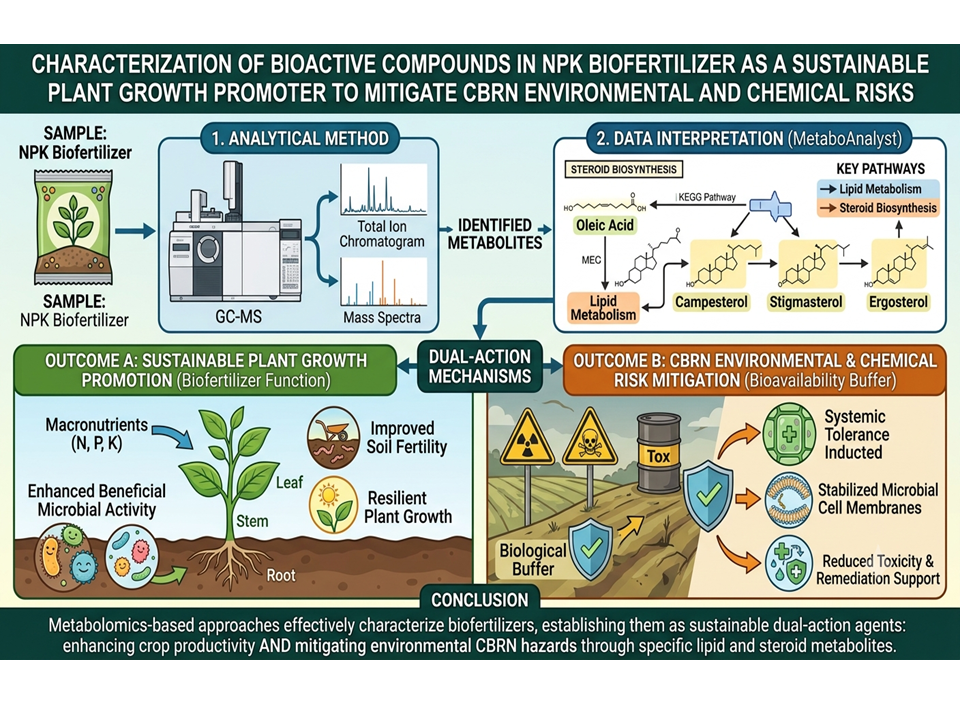
Metabolite analysis of NPK fertilizers based on biofertilizers was performed using Gas Chromatography-Mass Spectrometry (GC-MS) technique to identify the presence of bioactive compounds inside fertilizers. The identification of the metabolites revealed the presence of various metabolite compounds such as fatty acids, esters, alcohols, and sterol derivatives. Identified compounds were mapped using MetaboAnlayst and showed the association with steroid biosynthesis pathway. This pathway is associated with plant sterol, ergosterol, and brassinosteroid biosynthesis, which play roles in plant growth and soil microorganisms' activity. The existence of compounds like oleic acid and sterol derivatives indicates that NPK fertilizer can be utilized not only as a source of macronutrients but also as a biofertilizer that enhances soil biological activities and plant growth.
References
[1] Sihombing, G.S., Apriliani, D.N., Christi, B.H.W., Riandry, A., Aziz, S., Fendiyanto, M.H., & Pratami, M.P. 2025. Characterization of Jatropha curcas growth and semiquantitative ACCse gene expression by RT-PCR technique under drought treatment. MUNISI: Military Mathematics and Natural Sciences. 3(2). 79-85.
[2] Dzvene, A.R., & Chiduza, C. 2024. Application of biofertilizers for enhancing beneficial microbiomes in push–pull cropping systems: A review. Bacteria. 3(4). 271–286. doi: https://doi.org/10.3390/bacteria3040018
[3] Sun, W., Shahrajabian, M.H., & Soleymani, A. 2024. The roles of plant-growth-promoting rhizobacteria (PGPR)-based biostimulants for agricultural production systems. Plants. 13(5). 613. doi: https://doi.org/10.3390/plants13050613
[4] Areej, A., Usama, M., Zulfiqar, U., Sarwar, F., Maryam, & Ashiq, A. 2024. Sustainable agriculture development: The role of biofertilizers in soil fertility and crop yield improvement. Appl. Agric. Sci. 2(1). 1–5. Doi: https://doi.org/10.25163/agriculture.2110005
[5] Padhiary, M. and Kumar, R. 2024. Assessing the environmental impacts of agriculture, industrial operations, and mining on agro-ecosystems. In Smart internet of things for environment and healthcare (pp. 107-126). Cham: Springer Nature Switzerland. https://doi.org/10.1007/978-3-031-70102-3_8
[6] Fendiyanto, M.H., Setiawan, E., Pratami, M.P., Kurniyanto, I.R., & Fastanti, F.S. 2025. Construction of a CRISPR/Cas9-mediated genome editing system in manipulating OsART1 from Oryza sativa cv. Inpago 5. Biodiversitas. 5. 1-14. Doi: https://doi.org/10.13057/biodiv/d260241
[7] Fendiyanto, M.H., Kurniyanto, I.R., Setiawan, E., Pratami, M.P., Fastanti, F.S., Wosonowati, C., & Vardhana, D.P. 2025. Engineering of sgRNA targeting DREB4 isolated from Oryza sativa using pRGEB32 in CRISPR/Cas9 gene editing. SABRAO J. Breed. Genet. 57(3). 989-998. Doi: http://doi.org/10.54910/sabrao2025.57.3.11
[8] Pang, Z., Chong, J., Zhou, G., de Lima Morais, D.A., Chang, L., Barrette, M., Gauthier, C., Jacques, P.É., Li, S., & Xia, J. 2021. MetaboAnalyst 5.0: Narrowing the gap between raw spectra and functional insights. Nucleic Acids Res. 49(W1). W388–W396. Doi: https://doi.org/10.1093/nar/gkab382
[9] Pang, Z., Zhou, G., Ewald, J., Chang, L., Hacariz, O., Basu, N., & Xia, J. 2022. Using MetaboAnalyst 5.0 for LC–HRMS spectra processing, multi-omics integration and covariate adjustment of global metabolomics data. Nat. Protoc. 17. 1735–1761. Doi: https://doi.org/10.1038/s41596-022-00710-w
[10] Fendiyanto, M.H., Satrio, R.D., & Darmadi, D. 2020. Metabolic profiling and pathway analysis in red arillus of Salacca sumatrana demonstrate significant pyruvate, sulfur, and fatty acid metabolisms. Biodiversitas. 21(9). 4361–4368. doi: https://doi.org/10.13057/biodiv/d210950
[11] Fendiyanto, M.H., Anshori, M.F., Pratami, M.P., Wasonga, D.O., & Seleiman, M.F. 2024. Metabolite comparative variation related lipid metabolisms among fruit, leaf, and stem of Jatropha curcas. Biodiversitas. doi: https://doi.org/10.13057/biodiv/d250245
[12] Setiawan, E., Pratami, M. P., Kurniyanto, I.R., & Fendiyanto, M.H. 2025. Correlation analysis of the plant growth, leaf characters, and lipid metabolite markers in Jatropha curcas. SABRAO J. Breed. Genet. 57(5). 1862-1869. Doi: https://doi.org/10.54910/sabrao2025.57.5.8
[13] Kumar, R., Sindhu, S.S., Kumar, P., & Kumar, A. 2022. Biofertilizers: An ecofriendly technology for nutrient recycling and environmental sustainability. Current Research in Microbial Sciences. 3. 100094. Doi: https://doi.org/10.1016/j.crmicr.2021.100094
[14] Pereira, S.I.A., Abreu, D., Moreira, H., Vega, A., & Castro, P.M.L. 2024. Biofertilizers and biostimulants for sustainable agriculture: improving soil fertility and plant growth. Metabolites. 14(2). 102. Doi: https://doi.org/10.3390/metabo14020102
Downloads
Published
How to Cite
Issue
Section
License
Copyright (c) 2026 CBRNE Defense Studies

This work is licensed under a Creative Commons Attribution-ShareAlike 4.0 International License.