Microbial biofertilizer-induced fatty acid and squalene modulation for enhancing plant resilience under CBRNE-related abiotic stress
DOI:
https://doi.org/10.55749/cds.v1i1.166Keywords:
Abiotic Stress, Biofertilizer, Fatty Acid, Microorganism, SqualeneAbstract
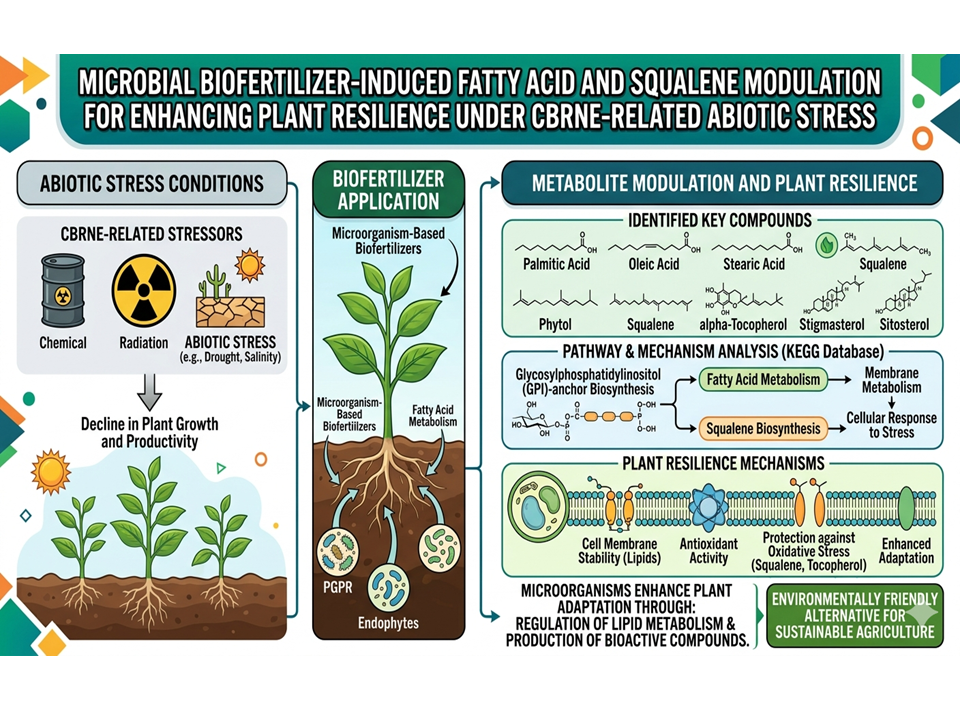
Abiotic stress is one of the main factors that cause a decline in plant growth and productivity. The use of microorganism-based biofertilizers can be an environmentally friendly alternative to enhance plant resistance to extreme environmental conditions. This study aims to analyze the role of microorganisms in biofertilizers on the profile of fatty acids and squalene related to plant abiotic stress resistance. Metabolite analysis was carried out using a metabolomic approach and metabolic pathway mapping through the KEGG database. Identification results showed the presence of important compounds such as palmitic acid, oleic acid, stearic acid, phytol, squalene, alpha-tocopherol, stigmasterol, and sitosterol. These compounds play a role in cell membrane stability, antioxidant activity, and protection against oxidative stress. Pathway analysis shows the involvement of the Glycosylphosphatidylinositol (GPI)-anchor biosynthesis pathway, which is related to membrane metabolism and the cellular response to environmental stress. The research results indicate that microorganisms in biofertilizers have the potential to enhance plant adaptation to abiotic stress through the regulation of lipid metabolism and the production of bioactive compounds. Thus, microorganism-based biofertilizers can be developed as an environmentally friendly alternative to support sustainable agriculture.
References
[1] Al-Turki, A., Murali, M., Omar, A.F., Rehan, M. and Sayyed, R.Z. 2023. Recent advances in PGPR-mediated resilience toward interactive effects of drought and salt stress in plants. Front. Microbiol. 14. 1214845. Doi: https://doi.org/10.3389/fmicb.2023.1214845
[2] Azzahroh, E.Q., Vardhana, D.P., & Fendiyanto, M.H. 2024. Carotenoid content test of drought-tolerant inpago paddy cultivars to support national food security. MUNISI: Military Mathematics and Natural Sciences. 2(2). 54-57.
[3] Ramadhan, D.P., Fendiyanto, M.H., Sihombing, O.D.E., & Vardhana, D.P. 2024. Oryza sativa cv. inpago 10 shows significant drought tolerance differences based on relative water content (rwc) for national food sovereignty. MUNISI: Military Mathematics and Natural Sciences. 2(2). 44-48.
[4] Sihombing, G.S., Apriliani, D.N., Christi, B.H.W., Riandry, A., Aziz, S., Fendiyanto, M.H., & Pratami, M.P. 2025. Characterization of Jatropha curcas growth and semiquantitative ACCse gene expression by RT-PCR technique under drought treatment. MUNISI: Military Mathematics and Natural Sciences. 3(2). 79-85.
[5] Cahyani, E. G., Azzahroh, E. Q., Fendiyanto, M. H., & Pratami, M. P. 2024. Enhancing food security: chlorophyll b content in several rice genotypes as an indicator of drought stress tolerance. MUNISI: Military Mathematics and Natural Sciences. 2(2). 49-53.
[6] Vardhana, D.P., Pratami, M.P., Ferdiyanto, M.H., Ramadhan, D.P., & Cahyani, E.G. 2024. Comparative study of chlorophyll a on several rice genotypes for food resilience against drought stress. MUNISI: Military Mathematics and Natural Sciences. 2(2). 40-43.
[7] Defsro, J.M., Ginting, C., & Wirianata, H. 2024. Pengaruh dosis unsur N dan waktu panen pada hasil dan kwalitas pada tanaman selada. Agroforetech. 2(3). 1082–1088..
[8] Elita, N., Erlinda, R., Yefriwati, Y., Sari, D.A., & Illahi, A.K. 2024. Peningkatan Kualitas Pupuk Hayati Diperkaya dengan Bakteri Pelarut Kalium, fosfor dan penambat nitrogen indigenous dari berbagai rizosfer tanaman padi terhadap kandungan hara dan jumlah populasi mikroba. Agroteknika. 7(4). 655–671. Doi: https://doi.org/10.55043/agroteknika.v7i4.418
[9] Utama, A.F., Adiningsih, A.S., Milasari, A.E., Cahyarani, R. M., Rahayu, T., Fendiyanto, M.H., & Satrio, R.D. 2023. The relationship of mutualism between the diversity of gut bacteria metabolism and the human body: a review. MUNISI: Military Mathematics and Natural Sciences. 1(1). 17-34.
[10] Fasusi, O.A., Cruz, C. and Babalola, O.O. 2021. Agricultural sustainability: microbial biofertilizers in rhizosphere management. Agriculture. 11(2). 163. Doi: https://doi.org/10.3390/agriculture11020163
[11] de Andrade, L.A., Santos, C.H.B., Frezarin, E.T., Sales, L.R. and Rigobelo, E.C. 2023. Plant growth-promoting rhizobacteria for sustainable agricultural production. Microorganisms. 11(4). 1088. Doi: https://doi.org/10.3390/microorganisms11041088
[12] Chaudhary, N., Mishra, M., Yadav, A.K., & Singh, N.K. 2026. Abiotic stress effects on polyunsaturated fatty acid biosynthesis in Chlorococcum oleofaciens and Leptolyngbya sp. Appl. Microbiol. Biotechnol. 110(1). 94. Doi: https://doi.org/10.1007/s00253-026-13754-9
[13] Fendiyanto, M.H., Setiawan, E., Pratami, M.P., Kurniyanto, I.R., & Fastanti, F.S. 2025. Construction of a CRISPR/Cas9-mediated genome editing system in manipulating OsART1 from Oryza sativa cv. Inpago 5. Biodiversitas. 5. 1-14. Doi: https://doi.org/10.13057/biodiv/d260241
[14] Fendiyanto, M.H., Kurniyanto, I.R., Setiawan, E., Pratami, M.P., Fastanti, F.S., Wosonowati, C., & Vardhana, D.P. 2025. Engineering of sgRNA targeting DREB4 isolated from Oryza sativa using pRGEB32 in CRISPR/Cas9 gene editing. SABRAO J. Breed. Genet. 57(3). 989-998. Doi: http://doi.org/10.54910/sabrao2025.57.3.11
[15] Fendiyanto, M.H., Anshori, M. F., Pratami, M. P., Wasonga, D. O., & Seleiman, M.F. 2024. Metabolite comparative variation related lipid metabolisms among fruit, leaf, and stem of Jatropha curcas. Heliyon. 10(15). e35861. Doi: https://doi.org/10.1016/j.heliyon.2024.e35861
[16] Arumsari, P., Tajudin, T., Indratmoko, S., & Issusilaningtyas, E. 2026. Potensi Squalen dalam Anti-aging: Tinjauan Literatur Review. Empiricism Journal. 7(1). 27–42. Doi: https://doi.org/10.36312/skqxqk05
[17] Bruce, J.S. and Salter, A.M. 1996. Metabolic fate of oleic acid, palmitic acid and stearic acid in cultured hamster hepatocytes. Biochem. J. 316(3). 847-852. Doi: https://doi.org/10.1042/bj3160847
[18] Setiawan, E., Pratami, M. P., Kurniyanto, I.R., & Fendiyanto, M.H. 2025. Correlation analysis of the plant growth, leaf characters, and lipid metabolite markers in Jatropha curcas. SABRAO J. Breed. Genet. 57(5). 1862-1869. Doi: http://doi.org/10.54910/sabrao2025.57.5.8
[19] Afrilliany, S.P., Shafira, K., Vivia M,Y., Sathi’ah, F.A., & Hidayah, H. 2024. Review Artikel : Fitosterol Dalam Bekatul dan. Jurnal Ilmiah Wahana Pendidikan. 2024(15). 672–687. Doi: https://doi.org/10.5281/zenodo.13833780
[20] Ikhwan, A. and Muhardini, D.T. 2014. Profit metobolit rhizobakteri toleran cekaman osmotik dan keasaman yang berpotensi sebagai pupuk hayati lahan kering asam. Jurnal Penelitian Ilmu-Ilmu Kelaman Buana Sains.14(2). 149-155.
[21] Rahmayuni, E., Vireza, V.R. and Herman, W. 2025. Efektivitas plant growth promoting rhizobacteria (pgpr) dalam meningkatkan pertumbuhan dan produktivitas mentimun (Cucumis sativus L.). In Prosiding Seminar Nasional Pembangunan dan Pendidikan Vokasi Pertanian. 6(1). 1290-1304. Doi: https://doi.org/10.47687/snppvp.v6i1.1871
[22] Xu, Z., Gao, Y., Gao, C., Mei, J., Wang, S., Ma, J., Yang, H., Cao, S., Wang, Y., Zhang, F. and Liu, X. 2022. Glycosylphosphatidylinositol anchor lipid remodeling directs proteins to the plasma membrane and governs cell wall mechanics. The Plant Cell. 34(12). 4778-4794. Doi: https://doi.org/10.1093/plcell/koac257
[23] Fujita, M. and Jigami, Y. 2008. Lipid remodeling of GPI-anchored proteins and its function. Biochimica et Biophysica Acta (BBA)-General Subjects. 1780(3). 410-420. Doi: https://doi.org/10.1016/j.bbagen.2007.08.009
[24] Setiawan, E., Fendiyanto, M. H., Kurniyanto, I. R., & Pratami, M. P. 2025. Comparative metabolomics studies related to lipid biosynthesis indicate metabolic pathways regulation differences in mature and young seeds (mys) of Jatropha curcas. Jordan J. Biol. Sci. 18(3). 509. Doi: https://doi.org/10.54319/jjbs/180314
[25] Kibret, M., Devkota, K., Bakrim, W. B., Ezzariai, A., Terefe, H., Karouach, F., Sobeh, M., Hafidi, M., & Kouisni, L. 2024. Plant growth promoting rhizobacteria mitigate drought and salinity stresses, and improve the physiological and agronomic performances in crops: A systematic review. Cabi Reviews. 19(1). Doi: https://doi.org/10.1079/cabireviews.2024.0025
[26] Constantia, J. and Ferniah, R.S. 2020. Vegetative growth of rainbow chili (Capsicum annuum L.) in the treatment of pgpr (plant growth promoting rhizobacteria), PGPR-NPK fertilizer, and PGPR-compost combination. Agric. 32(2). 95-104. Doi: https://doi.org/10.24246/agric.2020.v32.i2.p95-104
[27] Bhardwaj, D., Ansari, M. W., Sahoo, R. K., & Tuteja, N. 2014. Biofertilizers function as key player in sustainable agriculture by improving soil fertility, plant tolerance and crop productivity. In Microb. Cell Fact. 13. 66. Doi: https://doi.org/10.1186/1475-2859-13-66
Downloads
Published
How to Cite
Issue
Section
License
Copyright (c) 2026 CBRNE Defense Studies

This work is licensed under a Creative Commons Attribution-ShareAlike 4.0 International License.